JIATF 401 Explained: How the Pentagon’s New Counter-UAS Task Force Is Changing Drone Defense
Add bookmark
As small drones become cheaper, more capable and increasingly difficult to detect, counter-UAS has moved from a niche force protection concern to a central defense and homeland security priority.
The creation of JIATF 401 marks a major shift in how the Pentagon plans to coordinate counter-drone operations, accelerate procurement and deliver layered C-UAS capabilities across military, federal and domestic security environments.
This article explains why JIATF 401 was created, what its mission is, and how it could reshape the future of U.S. drone defense.
What is JIATF 401?
JIATF 401, or Joint Interagency Task Force 401, is the Pentagon's new counter-small unmanned aircraft systems task force. It was created to centralize, accelerate and coordinate U.S. counter-UAS activity across the Department of Defense, federal agencies and allied partners.
The task force replaces the former Joint Counter-small Unmanned Aircraft Systems Office, commonly known as the JCO, and reflects a major shift in how the U.S. government is responding to the drone threat. Rather than treating counter-drone defense as a service-by-service procurement problem, JIATF 401 is designed to act as a central authority for requirements, testing, acquisition, training, threat analysis and interagency coordination.
In IDGA's report, JIATF 401 and the Future of U.S. Counter-Drone Operations, the goal of the new office is described as "to better align authorities and resources to deliver C-UAS capabilities to U.S. warfighters and promote sovereignty over national airspace."
That mission matters because the drone threat is no longer limited to overseas combat zones. Small drones are now a battlefield, border security, critical infrastructure, airport, event security and homeland defense issue.
Why was JIATF 401 created?
JIATF 401 was created because the speed, scale and complexity of the small drone threat have outpaced traditional acquisition and coordination models.
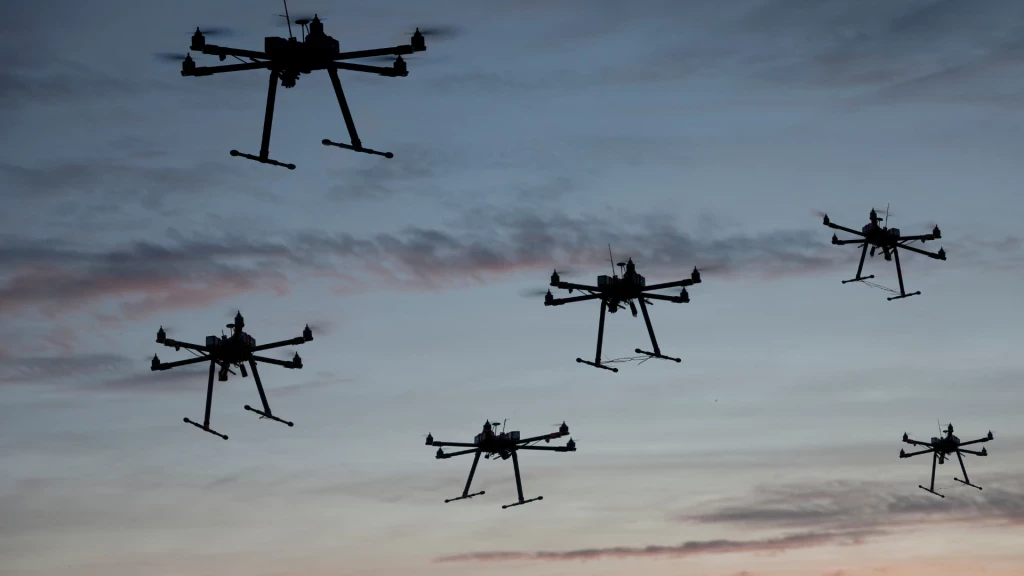
Commercial drones, FPV drones, one-way attack drones and low-cost uncrewed systems have changed the economics of airpower. Small systems that cost a fraction of traditional aircraft or missiles can now be used for reconnaissance, artillery spotting, infrastructure attacks, strike missions and psychological pressure.
The war in Ukraine has made this shift impossible to ignore. Ukraine and Russia have both used drones at huge scale for surveillance, targeting, strikes and electronic warfare. One of the clearest recent case studies is Ukraine's Operation Spiderweb. According to Associated Press reporting, Ukraine used 117 FPV drones concealed in wooden containers to strike Russian military airfields, damaging or destroying about 34 percent of Russia's fleet of air missile carriers and causing an estimated $7 billion in damage.
For U.S. defense leaders, the lesson is clear: small drones can create strategic effects. They can target high-value assets, overwhelm defenses, expose gaps in base protection and compress decision timelines.
IDGA's report states that the Ukraine-Russia conflict has provided global leaders with "a first-hand look at how modern warfare is conducted, including the significant threat posed by even the smallest, cheapest drones."
The U.S. has also seen the consequences of drone defense gaps directly. In January 2024, three U.S. service members were killed and dozens injured in a drone attack on Tower 22, a U.S. military outpost near the Jordan-Syria border. The Guardian reported that three U.S. troops were killed and more than 34 injured, while later reporting from The Washington Post highlighted failures around warnings, training, defensive equipment and drone identification.
JIATF 401 was created to solve exactly this type of problem: how to detect, understand, prioritize and defeat small UAS threats quickly, consistently and at scale.
Why JIATF 401 was created
What is JIATF 401's mission?
JIATF 401's mission is to synchronize counter-small UAS activity across the U.S. defense enterprise and help deliver counter-drone capabilities faster to operational users.
Our latest report outlines how "JIATF 401 synchronizes C-sUAS efforts across the DoW to rapidly deliver capabilities at scale to protect US and allied forces and assist federal agencies in defending critical infrastructure and the homeland."
That means the task force is not simply another policy office. It is intended to influence the full counter-UAS pipeline, from threat intelligence and R&D through to testing, procurement, training, fielding and operational support.
Key areas of responsibility include:
- Research, development, testing and evaluation for C-UAS capabilities
- Acquisition and procurement authority for selected systems
- Standardized testing and performance evaluation
- Drone forensics, exploitation and replication
- Support to federal agencies protecting homeland infrastructure
- Training through the Joint C-sUAS University
- Creation of a dedicated C-UAS test and training range
- Integration with Replicator 2 and other rapid fielding efforts
The scale of authority matters. Task force director, Brig. Gen. Matt Ross, will hold acquisition and procurement authority, including the ability to approve up to $50 million per initiative. That is a notable level of autonomy for a task force structure and signals the Pentagon's desire to move faster.
Why counter-UAS is now a homeland defense issue
Counter-UAS was once treated mainly as a deployed force protection problem. Today, the threat environment is broader.
Unauthorized or malicious drones can threaten military bases, nuclear facilities, public events, airports, ports, power infrastructure, borders, government sites and logistics nodes. This is why the U.S. counter-drone mission now crosses the boundaries between the Department of Defense, Department of Homeland Security, FBI, FAA, state and local authorities, and industry.
The White House's Restoring American Airspace Sovereignty executive order reflects this shift by placing greater emphasis on counter-drone enforcement and airspace security. At the same time, the related Unleashing American Drone Dominance executive order directed federal agencies to expand domestic drone production and reduce reliance on foreign-manufactured drones.
Together, these policy moves show that drones and counter-drones are becoming part of a wider national security strategy: build more trusted U.S. unmanned systems while also strengthening the ability to detect, track and defeat hostile or unauthorized drones.
For JIATF 401, this creates a dual mission: protect U.S. and allied forces abroad, while supporting federal agencies tasked with defending American airspace and critical infrastructure at home.
The role of Replicator 2 in counter-drone defense
Replicator 2 is another important part of the JIATF 401 story. The original Replicator initiative focused on accelerating the deployment of large numbers of autonomous systems. Reuters reported that the Pentagon selected two new drone types under Replicator, showing the department's continued push to move faster on autonomous and uncrewed systems.
Replicator 2 shifts the focus toward counter-drone systems. This is significant because it aligns directly with JIATF 401's mission: field counter-UAS capabilities quickly, scale promising technologies and reduce the friction between operational need and acquisition.
The challenge is not a lack of counter-drone technology. The market already includes radar, electro-optical sensors, acoustic detection, RF sensing, jammers, spoofers, high-power microwave systems, lasers, kinetic interceptors, nets, autonomous interceptors and command-and-control software.
The real challenge is deciding which combinations work in which environments.
A system that works for a deployed military base may not be appropriate for a crowded airport. A kinetic interceptor may be useful in a combat zone but too risky around civilians. Electronic warfare may be effective against some drones, but less useful against autonomous or pre-programmed systems. Directed energy may offer low cost per shot, but still faces scaling and reliability challenges.
This is why JIATF 401's role as a testing, procurement and coordination body is so important.
The counter-UAS kill chain
The counter-UAS marketplace: what changes for industry?
One of the most important implications of JIATF 401 is the creation of a counter-UAS marketplace.
The marketplace is expected to give DoD, DHS, FBI and even local law enforcement agencies a faster way to purchase counter-drone technologies. Rather than relying only on traditional service-led acquisition processes, vendors could enter a centralized environment where buyers can compare technologies based on standardized test results, authoritative performance data and real-world evaluation criteria.
For industry, this is a major change.
The marketplace could make it easier for non-traditional defense companies to reach government buyers, provided they can prove performance and interoperability. It may also create a more transparent environment where niche capabilities can be evaluated side by side.
This is important because there is no one-size-fits-all counter-drone solution. The right answer depends on the mission, location, threat type, legal authority, airspace environment and collateral risk.
For vendors, the message is clear: performance alone may not be enough. Systems will need to show they can integrate with a broader counter-UAS architecture.
Why interoperability and common C2 matter
One of the biggest problems in counter-UAS is not detection or defeat in isolation. It is connecting the full system.
A radar may detect a drone, but if that data cannot be shared with the command-and-control system, an operator may not have enough time to respond. A jammer may defeat one type of drone, but if the system is not connected to a wider threat picture, it may not be used effectively. A kinetic interceptor may be available, but rules of engagement and collateral risk may prevent its use in domestic environments.
That is why JIATF 401 is placing emphasis on a common command-and-control backbone.
Business Insider reported that the Army selected Anduril's Lattice software for an $87 million effort to link counter-drone systems and improve the ability to detect, track and respond to UAS threats. The deal sits within a wider framework that gives federal agencies access to a broader range of technologies over time.
For industry, this reinforces a central point: future counter-UAS systems will not be judged only on standalone capability. They will be judged on whether they can plug into a layered, interoperable system.
Which drone threats will JIATF 401 prioritize?
JIATF 401 is expected to prioritize Group 1 and Group 2 drone threats, where capability gaps remain.
These smaller UAS categories are particularly difficult because they can be cheap, widely available, low-signature and deployed in large numbers. They may be used for surveillance, targeting, harassment, explosive delivery or swarm-like disruption.
The challenge is that small drones are often hard to detect and identify early enough for a clean response. They may fly low, use terrain masking, operate in cluttered urban environments or avoid traditional air defense radars. They can also be modified quickly, making the threat highly adaptive.
A layered counter-UAS system therefore needs multiple detection and defeat options. A survey of counter-UAS technologies published by MDPI identifies detection methods including radar, radio-frequency analysis, acoustic sensors, electro-optical systems and data fusion, while mitigation methods include jamming, spoofing, capture and kinetic defeat.
For JIATF 401, the priority will be matching these technology categories to specific operational environments.
What JIATF 401 means for defense contractors
For defense contractors, JIATF 401 creates both opportunity and pressure.
The opportunity is a more direct route to buyers. A centralized marketplace, standardized testing and accelerated procurement could help vendors get in front of DoD and interagency customers faster.
The pressure is that expectations will rise. Vendors will need to prove their systems can work in realistic environments, integrate with common C2, meet standardized requirements and address specific operational gaps.
The strongest opportunities are likely to sit in:
- Low-collateral defeat systems for domestic environments
- Passive detection tools for border and infrastructure security
- Compact kinetic and non-kinetic systems for Group 1 and Group 2 drones
- Common C2 and sensor-fusion platforms
- Autonomous interceptors and low-power electronic warfare
- Testing, training and simulation solutions
- Drone forensics and exploitation tools
- AI-enabled threat detection and prioritization
What JIATF 401 means for U.S. counter-drone strategy
JIATF 401 signals that counter-UAS is becoming a permanent, scaled and interagency defense priority.
The U.S. government is moving away from fragmented service-level experimentation and toward a more unified model built around common requirements, shared testing, faster procurement and integrated C2.
For the counter-drone industry, that means the next phase of growth will be shaped less by individual point solutions and more by interoperability, evidence and mission fit.
The winners will be companies that can answer practical operational questions:
- Can the system detect small drones in cluttered environments?
- Can it distinguish hostile drones from friendly systems?
- Can it integrate into a common C2 layer?
- Can it operate legally and safely in domestic airspace?
- Can it support layered defense rather than a single defeat method?
- Can it prove performance through standardized testing?
- Can it scale quickly across bases, borders and critical infrastructure sites?
The creation of JIATF 401 is therefore more than an administrative change. It is a sign that the Pentagon sees drone defense as a strategic problem requiring centralized authority, faster acquisition and a stronger bridge between military operations and homeland security.
Key takeaways
JIATF 401 was created to centralize and accelerate U.S. counter-UAS efforts after years of fragmented requirements and slow fielding.
The task force is expected to play a major role in acquisition, testing, training, forensics, Replicator 2 integration and interagency coordination.
The counter-UAS marketplace could change how vendors reach government buyers by creating a more transparent, standardized and performance-driven procurement environment.
Small drone threats are now a defense, homeland security and critical infrastructure challenge, not just a deployed force protection problem.
For industry, the biggest opportunities will come from systems that are interoperable, layered, mission-specific and proven through realistic testing.
In short, JIATF 401 is changing U.S. drone defense by turning counter-UAS from a fragmented technology race into a coordinated national security mission.