Defense News Digest: November 2025 Update
Add bookmarkWelcome to IDGA’s weekly news roundup. For over two decades, IDGA has organized conferences designed to further the national security objectives of the current administration and to facilitate the acquisition priorities of the DoD, DHS, and other federal agencies. Now, through this weekly series, we look to educate the community on the latest research, program updates and news in the defense and government sector.
While the government shutdown and reforms to the Pentagon’s acquisition process stole headlines in November, for this exercise, we will examine four stories you might have missed, updates to the Army's counter-UAS efforts, and new defense industry investments from J.P. Morgan.
Army-Led Task Force to Launch Digital Marketplace for Counter-Drone Technologies
The Army-led Joint Interagency Task Force 401 (JIATF 401) is developing a digital marketplace to streamline how the Pentagon and domestic agencies acquire counter-drone technologies. Brig. Gen. Matt Ross said the platform will provide authoritative performance data and allow buyers across DoD, DHS, the FBI, and local law enforcement to quickly select systems, from detection sensors to non-kinetic effectors, tailored to their operational needs. The marketplace will launch alongside a similar Army UAS marketplace, though no timeline has been set.
Created in August to replace the former Joint Counter-small UAS Office, JIATF 401 has expanded authorities, including direct reporting to the deputy secretary of defense, procurement and acquisition power, and approval of department-wide c-UAS R&D efforts up to $50 million each. The task force is still finalizing its funding streams but expects resources to come from O&M, RDT&E, and procurement accounts.
Early work includes supporting Northern Command’s counter-UAS efforts along the southern border, where JIATF 401 is helping develop an integrated sensor network to track and defeat small drones. Ross said the task force is prioritizing improvements against Group 1 and 2 UAS, which pose increasing challenges across the homeland.
Army Eyes New Small-Drone Interceptor Program
In other counter-UAS news, the Army is laying groundwork for a potential new interceptor program aimed at defeating small drones, issuing a recent request for information (RFI) seeking industry-provided missile components. The solicitation, led by the Army Combat Capabilities Development Command’s Aviation and Missile Center, asks for mature seekers, batteries, control systems, mission computers, and other parts to build a database of technologies that could feed a future Counter-sUAS Interceptor program.
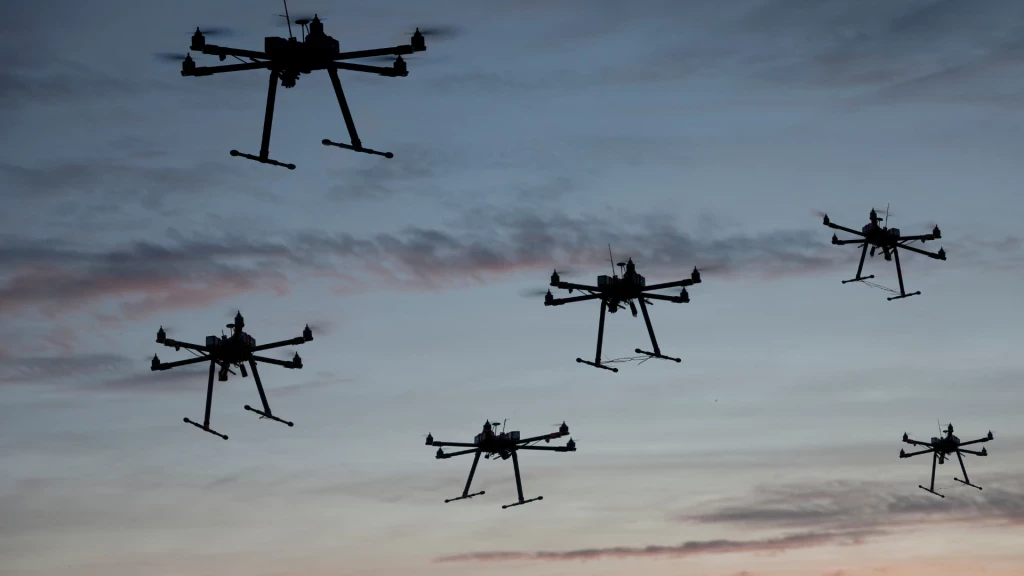
The Army’s push comes amid rapid global proliferation of Group 1 and 2 drones, which have proven highly lethal in conflicts like Ukraine by enabling low-cost, high-volume attacks that can overwhelm existing air defenses. While the Army is already advancing two interceptor programs—the eXtended Range Counter-sUAS (XRC) missile and the Next-Generation Counter-UAS Missile (NGCM)—both are geared toward larger Group 2–3 drones. The RFI highlights the remaining gap: an affordable, scalable interceptor solution for the smallest and hardest-to-detect drone classes.
To support rapid prototyping, the Army is specifically seeking COTS and GOTS components at TRL 5 or above, suitable for 40–70 mm missile bodies, tolerant to launch accelerations of 30 G, and producible at high volumes and low cost. Responses are due December 19.
F-22 Pilot Takes Direct Control of Drone Wingman in Landmark Test
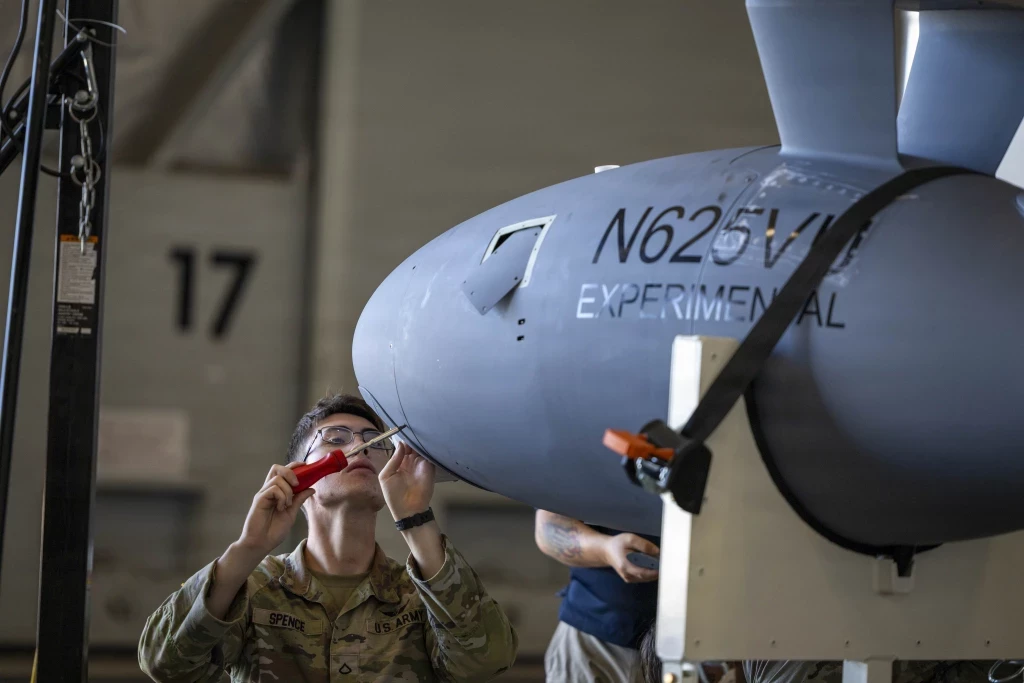
In a major milestone for the Air Force’s collaborative combat aircraft (CCA) program, an F-22 pilot successfully controlled an MQ-20 Avenger drone in flight, marking the first demonstration of manned-unmanned teaming with the Raptor. The Oct. 21 test over the Nevada Test and Training Range used a cockpit tablet to command and control the drone, according to General Atomics, which partnered with Lockheed Martin and L3Harris for the event.
The demonstration showcased non-proprietary, government-owned communications architectures, enabled through L3Harris datalinks and Lockheed’s open radio systems. General Atomics highlighted that its MQ-20, already a mature, operational uncrewed jet, is well-suited as a surrogate for future CCA platforms as the service prepares to award its first production design contract in 2026.
The achievement underscores accelerating industry efforts to prove real-world autonomy and teaming capabilities as competition for the Air Force’s CCA program heats up.
J.P. Morgan Launches $10B Defense Investment Push
In an exclusive interview with Breaking Defense, senior J.P. Morgan executives detailed a major new national-security push: a $10 billion investment commitment over the next decade aimed at strengthening the U.S. defense industrial base. The effort is part of the bank’s broader $1.5 trillion Security and Resilience Initiative (SRI), announced in October, which seeks to shore up critical sectors from defense to advanced manufacturing.
Executives Jay Horine and Mark Marengo emphasized that while J.P. Morgan will continue backing emerging venture-funded defense tech firms, a key priority will be supporting legacy suppliers, especially those tied to nuclear submarine production, a central element of the Pentagon’s long-term deterrence strategy toward China.
According to Marengo, the initiative will also target supply-chain bottlenecks in munitions and missile production, where U.S. stockpiles are projected to deplete quickly in major conflict scenarios. J.P. Morgan anticipates future SRI investments across both early-stage defense startups and long-standing qualified suppliers supporting primes like General Dynamics.