Space-Based Interceptors: The Hardest Technical Challenge in Golden Dome | IDGA Explainer
Add bookmark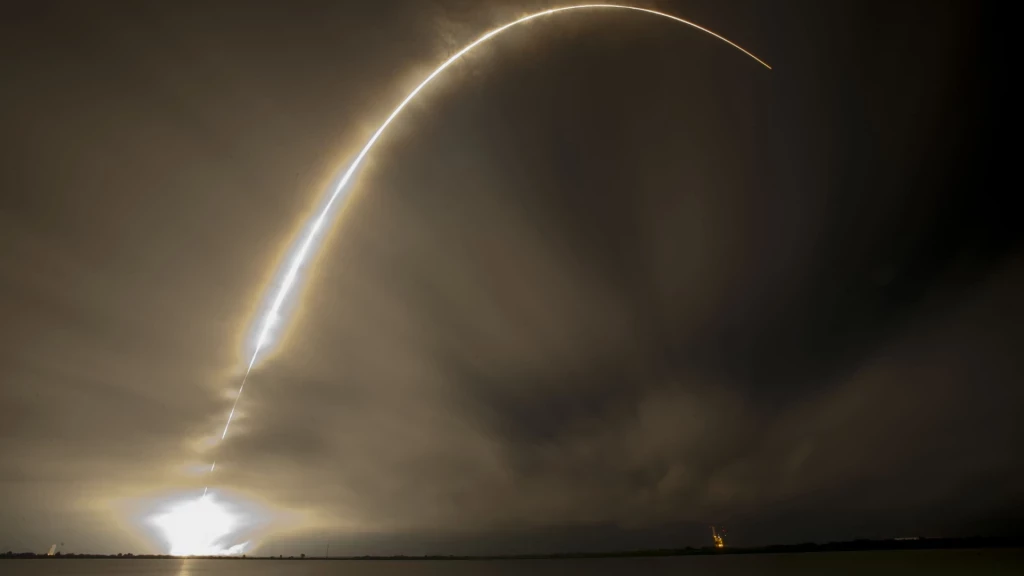
Space-based interceptors (SBIs) are the single most technically ambitious, and most closely watched, element of Golden Dome, the Pentagon's proposed homeland missile defense shield. The concept is straightforward to describe and extraordinarily difficult to build: satellites in orbit, armed with kinetic kill vehicles, positioned to destroy an enemy missile within the first few minutes after launch, before it can release warheads, decoys, or countermeasures. No country has ever fielded this capability. The U.S. Space Force is now betting billions of dollars that 2028 is the year that changes, funding competing prototypes with the goal of demonstrating an initial space-based interceptor capability integrated into Golden Dome by 2028.
This guide explains what space-based interceptors are, why boost-phase intercept is so difficult, why an almost identical idea failed in the 1980s, and where the current program, including $3.2 billion in contracts already awarded, actually stands today.
What Are Space-Based Interceptors?
Space-based interceptors are satellites designed to detect, track, and physically destroy a ballistic or hypersonic missile shortly after launch — most commonly during the missile's boost phase, the first few minutes of flight while its rocket engines are still firing. Rather than launching a defensive missile from the ground after an enemy missile is already in flight, an SBI is already in low Earth orbit (LEO), ready to strike the moment a threat is detected.
Golden Dome's SBI program specifically envisions a proliferated low-Earth-orbit (pLEO) constellation, meaning many smaller, distributed satellites rather than a handful of large ones, capable of engaging missiles across the boost, midcourse, and glide phases of flight.
Why Boost-Phase Intercept Is So Hard
The appeal of hitting a missile during boost phase is straightforward: it's the slowest, most predictable, and most vulnerable part of its flight. The missile hasn't yet released multiple warheads, decoys, or penetration aids designed to confuse a defender, there's just one large, hot, slow-moving target to track.
The problem is timing. Boost phase typically lasts only three to five minutes. For a space-based interceptor to reach the missile in that window, it has to already be close enough in orbit at the exact moment of launch, anywhere on Earth, at any time. Because no single satellite can be everywhere at once, guaranteeing that kind of coverage requires an enormous constellation. IDGA's explainer article on the Golden Dome covers this in more detail.
The Department of Defense has not publicly disclosed the planned size of Golden Dome's operational SBI constellation. In May 2026, the Congressional Budget Office modelled a notional 7,800-satellite interceptor layer capable of engaging ten nearly simultaneous ICBM launches, using two interceptors per target. That figure illustrates the potential scale and cost of persistent orbital coverage, but it is not a disclosed Pentagon force-design requirement.
That scale is the entire challenge in a single number. It's also why Golden Dome's own director has been candid about the risk: Gen. Michael Guetlein told Congress that boost-phase interceptors would only be fielded if they prove genuinely "affordable and scalable."
History: This Isn't the First Attempt
Space-based missile interceptors are not a new idea. In the 1980s, the Reagan administration's Strategic Defense Initiative (SDI), nicknamed "Star Wars", proposed a remarkably similar architecture, including a concept called Brilliant Pebbles: thousands of small, autonomous, space-based kill vehicles designed to intercept Soviet ICBMs during boost phase.
SDI never became operational. It ran into the same problems Golden Dome now has to solve: the program was too expensive, too technologically ambitious for the era, difficult to test realistically, and in tension with the Anti-Ballistic Missile Treaty then in force. The comparison isn't just historical trivia, it's the most obvious skeptic's argument against Golden Dome's SBI layer, and it's one that Golden Dome's own leadership has to answer as the program moves from concept to contract.
The comparison to Israel's Iron Dome, which some early coverage used as shorthand for Golden Dome, is also worth being precise about. Iron Dome defends an area roughly the size of New Jersey against a single adversary's conventional, short-range rockets, with limited countermeasures. Golden Dome's SBI layer is designed to defend the entire U.S. homeland against ballistic, hypersonic, and cruise missiles from multiple nations, potentially including nuclear-armed peer adversaries employing decoys, chaff, and jamming. It's a fundamentally larger and harder problem, not a scaled-up version of the same one.
Inside the 2026 Contract Awards
The current program is real money, not just a concept paper. In April 2026, the Space Force's Space Systems Command announced it had awarded 20 Other Transaction Authority (OTA) agreements worth up to a combined $3.2 billion to 12 companies to develop space-based interceptor prototypes. The awards, made across late 2025 and early 2026, deliberately mix traditional defense primes with newer entrants: Lockheed Martin, Northrop Grumman, RTX's Raytheon, and General Dynamics Mission Systems sit alongside SpaceX, Anduril Industries, Booz Allen Hamilton, GITAI USA, Quindar, Sci-Tec, True Anomaly, and Turion Space.
Using OTAs rather than traditional contracts was a deliberate choice as it lets the Space Force fund multiple competing designs at once rather than betting early on a single prime contractor. As Col. Bryon McClain, Program Executive Officer for Space Power, put it, the acquisition approach is designed to keep pace with adversary capabilities that are advancing faster than traditional procurement timelines allow.
The stated goal is to demonstrate an initial space-based interceptor capability integrated into the Golden Dome architecture by 2028, an aggressive schedule for a technology that has never been fielded by any country.
Where SBIs Fit in Golden Dome's Layered Defense
Golden Dome is a layered architecture designed to engage a missile at multiple points across its flight, so that a miss at one layer can potentially be caught at the next.
Diagram: Missile flight phases and where space-based interceptors fit into Golden Dome's layered defense
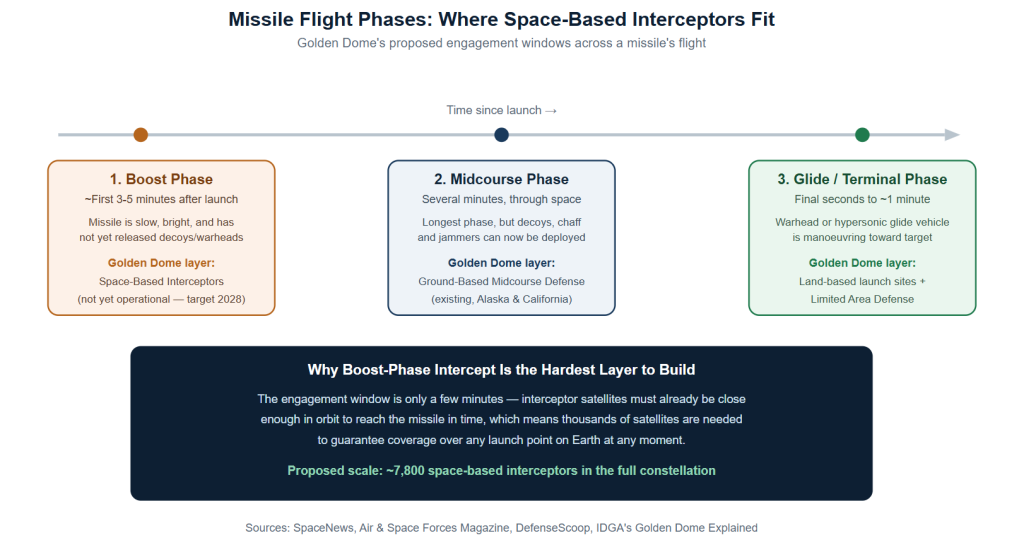
Boost, Midcourse, and Terminal Intercept Compared
| Boost Phase | Midcourse Phase | Glide / Terminal Phase | |
|---|---|---|---|
| Approximate duration | 3-5 minutes | Several minutes, through space | Final seconds to ~1 minute |
| Missile characteristics | Slow, bright rocket plume, no decoys deployed yet | Decoys, chaff and jammers can now be deployed | Maneuvering warhead or hypersonic glide vehicle |
| Golden Dome defense layer | Space-Based Interceptors (SBI) | Ground-Based Midcourse Defense (existing) | Land-based launch sites + Limited Area Defense |
| Current maturity (2026) | Prototype stage — target 2028 | Operational (Alaska & California) | Planned, sites not yet finalized |
| Primary technical challenge | Orbital coverage — satellites must already be in range | Distinguishing warheads from decoys | Extremely short reaction time |
What This Means for the Defense Industrial Base
The SBI contract structure signals something important beyond the technology itself: the Pentagon is deliberately broadening who gets to compete for Golden Dome work. Traditional primes are being funded alongside venture-backed space startups under the same milestone-driven, competitive framework, a meaningful shift for companies that have historically struggled to break into missile defense procurement.
As IDGA's own report notes, Golden Dome overall marks a significant shift in U.S. missile defense policy, expanding the homeland defense mission beyond rogue-state ICBMs to cover the broader mix of ballistic, hypersonic, and advanced cruise missile threats posed by peer and near-peer adversaries. Of the technology funding tied to this shift, $18.8 billion has specifically been directed toward next-generation missile defense capabilities, including space-based sensors, boost-phase interceptors, hypersonic test programs, directed energy, and expanded satellite capacity.
Frequently Asked Questions
What is a space-based interceptor? A space-based interceptor is a satellite armed with a kinetic kill vehicle, positioned in low Earth orbit to detect and physically destroy an enemy missile shortly after launch — typically during its boost phase, before decoys or multiple warheads can be deployed.
Do space-based interceptors exist yet? No fully operational space-based interceptor system exists yet. As of 2026, the U.S. Space Force has awarded prototype development contracts worth up to $3.2 billion to 12 companies, with a target of demonstrating initial capability by 2028.
Why is boost-phase intercept considered the hardest part of missile defense? Because the boost phase only lasts three to five minutes, an interceptor satellite must already be close enough in orbit to reach the missile in time. Guaranteeing that coverage anywhere on Earth requires a very large constellation of satellites — Golden Dome's full concept calls for roughly 7,800 space-based interceptors.
Has a space-based missile interceptor system been tried before? Yes. The Reagan administration's 1980s Strategic Defense Initiative, including a concept called Brilliant Pebbles, proposed a similar space-based boost-phase intercept architecture. It was never fielded, largely due to cost, technological immaturity for the era, testing difficulties, and conflict with the Anti-Ballistic Missile Treaty.
Which companies are building Golden Dome's space-based interceptors? Twelve companies hold current prototype contracts: Anduril Industries, Booz Allen Hamilton, General Dynamics Mission Systems, GITAI USA, Lockheed Martin, Northrop Grumman, Quindar, RTX's Raytheon, Sci-Tec, SpaceX, True Anomaly, and Turion Space.
Further Reading
Golden Dome Explained: What the U.S. Missile Defense Shield Means for Space, Hypersonics and Homeland Defense
What to Know About the Pentagon's Golden Dome
A Guide to the DoD's Hypersonic Attack Missiles
Implications of the U.S. Army Delivering Its Long Range Hypersonic Weapon
Next Generation Missiles and Hypersonics Summit — 2026 agenda
Golden Dome, space-based tracking, and the broader missile defense industrial base will be discussed in depth at IDGA's Next Generation Missiles and Hypersonics Summit.