One Year On: How the Armed Force’s CCA Programs Have Matured
Add bookmarkListen to this content
Audio conversion provided by OpenAI

Collaborative Combat Aircraft (CCA), the Air Force’s autonomous wingman program, had an eventful year in 2025. The program down selected in Increment 1, and the finalists have began to publicly announce prototype testing. Meanwhile, both the Navy and Marines have joined the Air Force in establishing CCA programs, and 2026 is expected to be an exciting year for the respective service branches' CCA programs.
In late 2024, IDGA published an article highlighting progress made on CCA that year. Now, nearly a year later, we are here to take on that same endeavor. This article will highlight everything you might have missed over the past year of the Air Force's CCA, as well as dive into progress on the Navy’s, Marines', and Army's own CCA programs.
If you would like to hear directly from the men and women leading CCA programs across the armed forces, register for IDGA’s Air Dominance Summit. The two-day conference will bring together leaders from across the defense and aerospace communities, including the U.S. Air Force, the U.S. Navy, allied nations, industry, to discuss sixth-generation fighter program, sustainment of current systems, logistics challenges, reflect on current conflicts, advanced weapon systems, and explore innovation in air supremacy.
Air Force CCA takes next step in 2025
In 2023, the Air Force became the first DoW branch to launch a CCA program, making it the furthest along amongst the armed services.
A November 2025 report by Congressional Research Service (CRS) provides the best summary of where CCA stands. In the report, CRS describes CCA as having moved decisively from concept and experimentation into early operational prototyping, with Congress now shifting into a more active oversight role as funding, scale, and autonomy questions come into sharper focus.
Increment 1 update
Increment 1 of CCA, which focuses on developing and fielding the initial semi-autonomous drone wingman, is at the point where prototypes have been built, and flight tests are in progress. The finalists for CCA Increment 1 include:
- Anduril YFQ-44A: Anduril’s CCA finalist is an AI-powered semi-autonomous unmanned combat aerial vehicle known as the “Fury.” The first tests for the platform took place in October 2025.
- General Atomics Aeronautical Systems (GA-ASI) YFQ-42A: GA-ASI, the other CCA finalist in increment 1, is another uncrewed jet focused on air-to-air semi-autonomous operations. The first flight for General Atomics system took place in August 2025.
Both these aircrafts are undergoing developmental testing in California and participating in operational assessments through an Experimental Operations Unit at Nellis Air Force Base. The CRS report also notes that the Air Force has selected Beale Air Force Base in California as the preferred location for a CCA Aircraft Readiness Unit intended to support rapid deployment. Taken together, these developments indicate that Increment 1 is being used as an operational learning platform rather than a purely experimental effort.
Increment 2 update
CRS reports that preliminary work on Increment 2 has begun, though requirements remain deliberately flexible. The Air Force intends to work with a much broader industrial base during this phase, potentially involving more than 20 companies, including firms that were not selected for Increment 1. Contracts for Increment 2 could be awarded as early as the beginning of FY2026. Already, Northrup Gruman has joined CCA when the company's new autonomous drone wingman, known as Talon, received official designation in December.
Increment 2 is not characterized as a dramatic leap in sophistication or stealth. Instead, it reflects Air Force messaging that Increment 2 requirements will be shaped by lessons learned from Increment 1 flight testing and operational experimentation. This approach suggests a focus on refining capabilities, improving affordability, and validating scalable concepts rather than pursuing a clean-sheet design.
Navy progress on CCA
The Navy’s own CCA program has accelerated in the past 12 months. However, unlike the Air Force, which has publicly designated and flown Increment 1 CCA prototypes, the Navy is still in a concept development and requirements-shaping phase, closely tied to the future of its sixth-generation fighter program, F/A-XX.
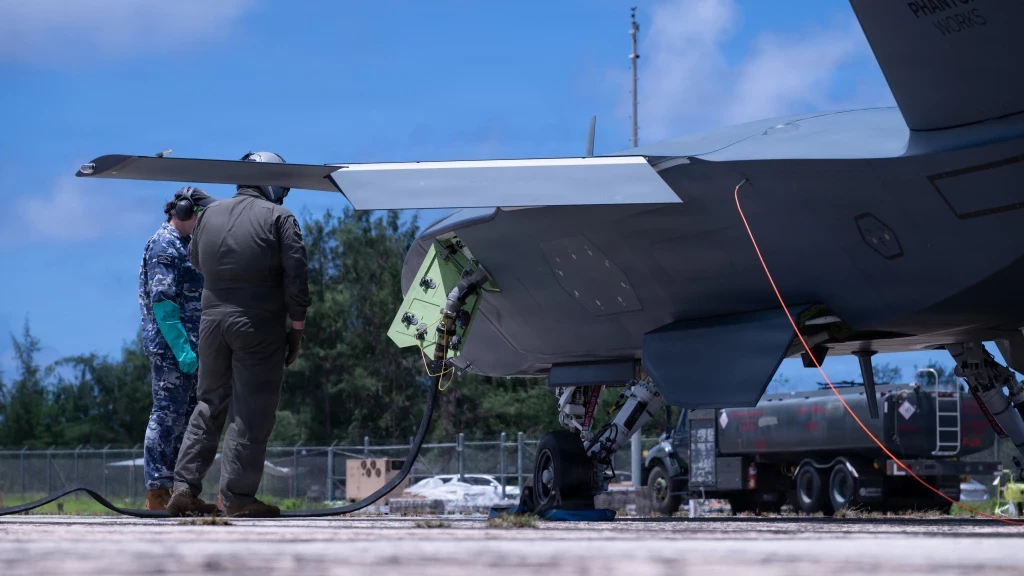
The program began in 2024, the Navy announced plans to field CCAs by 2030, and planned exercises with Australia for manned-unmanned teaming.
This past October, Air & Space Forces Magazine reported the Navy had issued multiple CCA concept development contracts to industry partners including Anduril, Boeing, General Atomics, and Northrop Grumman, while Lockheed Martin is separately developing a common control system. The magazine added that the Navy has not formally acknowledged these awards, largely because it has been waiting to clarify the path forward for F/A-XX, which will significantly influence how Navy CCAs are designed, integrated, and fielded.
Marines CCA poised for big year
The Marines CCA equivalent, known as the Marine Air-Ground Task Force Uncrewed Expeditionary Tactical Aircraft (MUX TACAIR), made headlines in early January by awarding a $231.5 million other transaction agreement to a Northrop Grumman–led team, with Kratos as the primary platform partner.
Under the 24-month development agreement, Northrop Grumman will serve as the sole prime contractor, integrating its mission kits and Prism open-architecture autonomy software onto Kratos’ XQ-58A Valkyrie air vehicle.
The MUX TACAIR award builds directly on earlier Marine Corps experimentation with the XQ-58A under the Penetrating Affordable Autonomous Collaborative Killer-Portfolio (PAACK-P) effort, which was funded through the Pentagon’s Rapid Defense Experimentation Reserve. Those flight tests allowed the service to mature requirements and assess how an affordable, attritable uncrewed aircraft could support Marine expeditionary operations.
Like the Air Force and Navy, the Marine Corps plans to develop and field its CCA capability incrementally. The Northrop–Kratos contract covers Increment 1, with future advancements expected to add new capabilities across command and control, electronic warfare, mission computing, and datalinks. Budget documents indicate that each minimum viable capability increment will be structured to support training and tactics development with operational units, rather than delaying fielding until a fully mature system is achieved.
For FY2026, the Marine Corps requested $58 million to continue MUX TACAIR research and development, with funding aimed at delivering a fully missionized prototype capable of conventional takeoff and landing and demonstrating key system attributes during the fiscal year.
Army eyeing CCA program of its own
The Army is the last service branch to begin developing manned-unmanned aircraft teaming concepts.
In late 2025, Army leadership publicly confirmed for the first time that it is pursuing a Collaborative Combat Aircraft–like capability. Senior Army aviation leaders indicated the service could field an initial capability within the “next couple of years,” pending continued experimentation and requirements development.
Brig. Gen. Cain Baker, director of the Army’s Future Vertical Lift Cross Functional Team, told reporters at AUSA this October the Army has spent the past year closely studying CCA developments across the Air Force and Navy while conducting its own experimentation. Rather than launching a formal program of record immediately, the Army is using ongoing tests and industry engagement to define what a CCA-like system should look like for land-centric operations.
Unlike the Air Force’s jet-powered CCAs, the Army’s interest is closely tied to its broader autonomous air portfolio, which already includes launched effects and unmanned aerial systems designed to provide sensing and strike capability. Army leaders say that the core appeal of a loyal wingman concept is the ability to deliver mass to commanders while reducing risk to aviators.
The Army plans to continue evaluating CCA-like technologies during its annual aviation experimentation events in the second quarter of FY2026.