Exclusive Content
Military Simulation Training Summit | Convince Your Boss
Are you looking to attend IDGA's upcoming Military Simulation Training Summit? Do you need help signing off your attendance?
See why this is the room you need to be in, and help shape the future of simulation & training strategies.
2026 Sample Attendee List
See who will be in attendance at IDGA's fourth annual Military Simulation Training Summit, the premier event for the military & simulation training community.
The 2026 edition promises to deliver critical engagements at a pivotal time for the industry, at a time where recent global conflicts are creating complicated military landscapes, causing the US and allied forces to increase military training investment.
Who can you meet on site?
- US Army - including programs such as the CPE STRI
- US Navy
- US Air Force
- US Coast Guard
- Marine Corps
- NATO
- 5+ international militaries
Download today to find out more about this exclusive audience and intimate format.
How the Marine Corps is Shaping Expeditionary Training Through Project Tripoli
Colonel Ryan Harrington, Commanding Officer of Expeditionary Warfare Training Group, Atlantic, brings decades of experience across intelligence, reconnaissance, and expeditionary warfare to one of the Marine Corps’ most ambitious training initiatives: Project Tripoli.
Set to roll out in 2025, Project Tripoli will provide Marines with a Live, Virtual, and Constructive Training Environment (LVC-TE) that is globally available across all domains and echelons. As a key advisor on expeditionary training for the program, Colonel Harrington has been shaping how Tripoli will prepare Marines to think critically, adapt quickly, and operate effectively in contested environments.
Colonel Harrington is set to address the military training community this February at IDGA’s Military Simulation Training Summit, taking place in Orlando, Florida. At the summit, Colonel Harrington will discuss Project Tripoli and the future LVC training. But before the event, Colonel Harrington sat down with IDGA to share insights on the future of training, the value of blending live and virtual environments, and the pressing gaps the Corps must address to modernize expeditionary readiness.
A Guide to Simulation Training in the U.S. Navy
IDGA’s Military Simulation Training Summit provides the U.S. DoD, as well as its international and industry partners, an opportunity to share knowledge and showcase the evolution of simulation and simulated training across the military branches and NATO nations.
One service branch that has been a leader in simulation training discussions is the U.S. Navy, which is constantly on the lookout for Live, Virtual (LVC) platforms that can prepare sailors for operations both in water and on land.
This year’s Military Simulation Training Summit will feature speakers from the Navy, including Christopher Boyle, LVC Training Technology Director of U.S. Fleet Forces Command. Before these leaders join their military peers in Orlando, Florida this February 24- 25, IDGA has created this guide to understanding the Navy’s history in the realm of simulation training and highlight some of the service branches’ current capabilities.
From Virtual to Real-World Readiness at the Military Simulation Training Summit
The U.S. military is continuously modernizing and preparing its soldiers for the complexities of future warfare, and simulation and synthetic training environments have become central to building troop readiness. IDGA’s Military Simulation Training Summit, returning to Orlando, FL on February 24–25, 2026, will support the U.S. military’s mission by bringing together leaders from the Army, Navy, Air Force, Marine Corps, and allied nations to explore the latest trends shaping simulation training. This year’s program will focus on advancing interoperability, leveraging emerging technologies, and evolving training methods to meet the demands of multi-domain and coalition operations. At the helm of this year’s summit is Brigadier General William R. Glaser (Ret.), the only simulation officer promoted to general in the US Army and former Director of
the Synthetic Training Environment Cross Functional Team (STE CFT). A decorated armor officer and simulation expert, Brig. Gen. Glaser brings unparalleled understanding through 30+ years of military leadership in operations, training, and simulation organizations. Throughout his distinguished career, he has integrated technology, training, and operational readiness—from leading soldiers in Iraq to directing the National Simulation Center. As STE CFT Director, he transformed Army training by developing synthetic capabilities replicating modern warfare complexities. He now serves as the Chief Growth Officer for AVT Simulation.
In this pre-conference interview, Brig. Gen. Glaser discusses how multinational collaboration enhances training integration, what lessons the simulation community can draw from real-world conflicts like Ukraine, and why synthetic environments are vital to ensuring that no Soldier ever cries out, “if only I had proper training.”
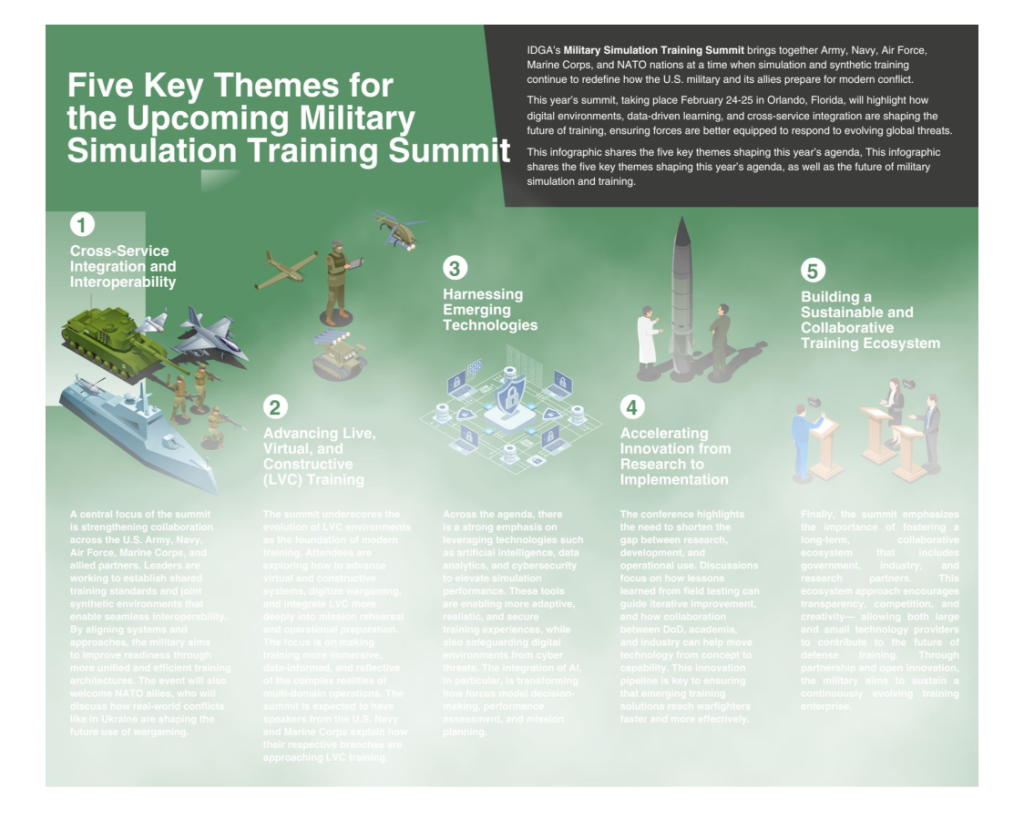
Five Key Themes for the Upcoming Military Simulation Training Summit
IDGA’s Military Simulation Training Summit brings together the Army, Navy, Air Force, Marine Corps, and NATO nations at a time when simulation and synthetic training continue to redefine how the U.S. military and its allies prepare for modern conflict.
This year’s summit, taking place February 24-25 in Orlando, Florida, will highlight how digital environments, data-driven learning, and cross-service integration are shaping the future of training, ensuring forces are better equipped to respond to evolving global threats.
This infographic shares the five key themes shaping this year’s agenda, as well as the future of military simulation and training.
Building the Army's AI Future
At this year’s Military Simulation Training Summit in Orlando, Florida, one of the key topics will be the impact of AI on simulation training. Experts from across the US military and defense industry will converge in Orlando to discuss and share the latest developments and research in AI, including Dr. Keith Brawner from the Institute for Creative Technologies University Affiliated Research Center (ICT UARC).
Dr. Brawner serves as the AI Lead and Program Manager of the ICT UARC for US Army DEVCOM Soldier Center, on behalf of the Undersecretary of Defense for Research and Engineering. In his career Dr. Brawner has served as a research leader in intelligent tutoring systems with over 100 publications in research/application of simulation and training technologies. In addition, he has worked on, or contributed to, systems which train land navigation, marksmanship, hovercraft operation, destroyer decision making, physics, UAV route planning, calling for indirect fires, submarine harbor navigation, sonar system operation, helicopter flight, counterinsurgency, and so many others. Before the most recent iteration of the Military Simulation Training, IDGA sat down with Dr. Brawner to discuss the future of AI and synthetic modeling in military training. The 2026 version of the Summit is set to return this February in Orlando, Florida.
Besides the use of AI in military training, the upcoming Military Simulation Training Summit will also explore interoperability, expansion, and implementation of military-simulated training, as well as a range of training types such as LVC, armored vehicles, and training procurement.
The Future of Simulation Training in the National Guard
When it comes to military training most people envision active duty service members at bases such as Fort Moore or Fort Liberty. However, with over 430,000 citizen Soldiers the National Guard also faces a large responsibility when it comes to preparing personnel for domestic crises and overseas conflict.
Lieutenant Colonel Gordon Kinneer is the Operations Officer (S3) at Fort Indiantown Gap Training Center in Pennsylvania, where he also holds the title of Director of Plan Operations, Training, and Security. In over two decades of experience in the National Guard, including roles such as the State Simulations Officer at Fort Indiantown Gap, Lt Col Kinneer is passionate about integrating simulation technologies into training and leveraging his expertise to enhance operational readiness within the National Guard.
This past February, Lt Col Kinneer joined a panel of fellow National Guardsmen to discuss simulation training at IDGA’s Military Simulation Training Summit. The two-day event is set to return from February 24-25 in Orlando, Florida. This year’s summit will showcase the evolution of simulation and simulated training across the military branches and NATO nations. The conference will also extensively explore interoperability, expansion, and implementation of military-simulated training.
Below is the full conversation Lt Col Kinneer had with IDGA before participating in the summit.

Training the Next-Gen NATO Warrior; Interview with Colonel Steve Banks, Branch Head of Modelling and Simulation Learning Technology
Speaking at our event in 2024, Colonel Steve Banks delivers this exclusive interview in preparation for our Land Forces Training Conference. This piece is ideal for anyone wanting to better understand NATO efforts in training the next warfighter. It maps out the current priorities of the Modelling and Simulation Learning Technology branch as well as the technologies that have caught its attention. Furthermore, it delves into the impact the Ukrainian War on training concepts.

Training for Everything, Ready for Anything; Interview with Major General Pelletier
In the age of near-peer competition, the warfighter must be ready to take on more challenges than ever before. To prepare the warfighter training must adapt to suit the needs of the battlefields of the future which will arguably be more complex and lethal. We had the privilege of interviewing the Major-General Roch Pelletier, Commander of the Canadian Army Doctrine and Training Centre (CADTC). Here he delves into:
- How CADTC is preparing Canadian forces for future combat in the current geopolitical landscape.
- The role technology and industry play in training the warfighter.
- How to set the appropriate limitations for training.

Bringing it all Together, Interview with Daniel O' Torgler
As our doctrine shifts towards multidomain warfare, our training and simulation tools must also adapt. Partner to the Land Forces Training 2024 conference, Team Orlando’s mission is to maximize DoD resources to deliver these first-rate training capabilities to the nation’s Warfighters by coalescing the training, simulation, and modelling communities. Find more about Team Orlando’ efforts by reading this interview with the organization’s Director, Daniel Torgler.

HOW CAN WE UTILIZE OFF-THE-SHELF-SIMULATIONS TO OPTIMIZE THE READINESS OF OUR LEADERS AND SOLDIERS?
Professor David Benson delivers commentary on the evolving area of study of video games in the military. He delves into how video games play a critical role in “force development” and maintaining readiness and why it is a worthy area of study. In his preliminary research, he covers:
- Gaps in the public research
- What video games offer the military domain
- How video games can help to maximize the proficiency of our forces
- A call to action for further study across stakeholders

How Can We Ensure Troops Are Mission-Ready?-Survey Report
Land Forces Training is a complex, multifaceted domain in constant evolution as new technologies and ways to fight emerge. In this survey, we asked several representatives from military, academic, industry and government backgrounds to answer questions based on the current state of play and the future of the domain. The results were both revealing and surprising as they gave insight into the following:
- The barriers to mission readiness
- The opinions of Synthetic Training vs Live Training
- The dissonance in priorities between the military and industry

Key Land Forces Training Initiatives Market Map
The importance of training cannot be understated. The age-old axiom of “the more you sweat in training, the less you bleed in combat” remains as true as ever. In this piece, IDGA gives a quick birds-eye-view of the key training initiatives happening world-wide in 2023; ideal for someone wanting a quick update in the latest happening in the domain.

2023 Attendee Snapshot
Curious to see who typically attends Land Forces Training Summit where attendees gain unrivalled insights from senior military leaders from the U.S. and allied nations?
View the attendee's snapshot to find out which companies of key stakeholders in training and doctrine, training technology, tools, and simulation, to collaboratively focus on how warfighter readiness can be optimized for the future operational environment and emerging threats, who attended in 2023.

Land Forces Training: A market overview
Training methods for land forces need to be re-assessed, as ground combat doctrine moves towards multi-domain operations against peer competitors. Commercial off-the-shelf technologies are put under the spotlight as NATO nations turn towards them to enhance their troops’ training and readiness.
Ahead of Land Forces Training, Defence IQ surveyed experts from the armed forces – both serving and retired – from all around the world. In the results of the survey, learn more about:
- What will impact land forces the most in the next 10-15 years
- What they want to achieve through training and the challenges they encounter
- Their investment priorities in simulation training
- How they rate the importance of training and the consequences of insufficient training
- Their opinion on the current industry offering for training solutions

Unique remote firing system set for worldwide demo
Chemring Technology Solutions is preparing its widely anticipated LoRIS (Long-range Radio Initiation System) for international demonstrations and full verification of its safety and suitability for military application, following a successful product launch in March. Ahead of Land Forces Training

SCIENCE FICTION NO LONGER: ENHANCING MILITARY READINESS THROUGH SYNTHETIC TRAINING
Today, the live training environment is not conducive to many of the training needs of fifth generation platforms: live training ranges are spatially too restricted, fail to produce realistic threat scenarios, and risk revealing the unique war fighting attributes of platforms. These barriers are pressing military operatives to rethink live training in favor of more realistic missions in virtual environments. In this exclusive article, Jennifer argues why a blend of techniques, known as live, virtual, and constructive (LVC) training is increasingly viewed as the future of military training.

Preparing the army of the future: TRADOC's role in shaping the future land forces
The battlespace is increasingly complex and requires land forces to be flexible and have mobility while preserving their lethality, using systems that are more and more digitised.
This exclusive interview with General David G. Perkins, Commanding General at the U.S. Army Training and Doctrine Command, provides insight into the next generation warfare and its implications on the procurement decisions and assets design for the land forces of tomorrow.

Swedish Army training system acquisition for the future environment
In this exclusive interview with Major General Karl Engelbrektson, Commander of the Swedish Army who will speak at the Land Forces Training conference, learn more about how the Swedish Army is preparing for the future operating environment. Download this interview to find out more about his take on:
- The 2025-2035 operating environment
- What Sweden is doing to ensure current training capabilities will be effective at preparing personnel in the future operating environment
- The role and importance of new technologies for land forces training
- The importance of industry in the design and delivery of new capabilities

The importance of a land power narrative in an ever-evolving battlefield
Land power is indispensable to achieve strategic objectives on the ground. The battlefield is changing and new threats and enemies are emerging, creating new procurement requirements and challenges for armed forces and the armoured vehicle community needs to adapt to this evolution.

The Canadian Armed Forces' training modernisation programme
In this exclusive interview, Major General Stephen Cadden, Commander of the Canadian Army Doctrine & Training Centre and speaker at this year’s Land Forces Training discusses the modernization of the Canadian training programme, and the importance of industry in delivering the right solutions to prepare for future operations.
In Partnership With:

QUESTIONS?
Contact us: +1 646 200 7515
Email: idga@idga.org

©2026 IQPC. All rights reserved.