

December 9 - 10, 2025
| Sheraton Reston Hotel, Reston, VA
Not Using
Systems Engineering Approach to Hypersonics: A Space Domain Perspective
The navigation and guidance technologies within a hypersonic weapon are key to making them successful in an operational capacity. The demands of space amplify the challenges of tracking at high speed as the extreme temperatures can compromise these assets.
- Ensuring that Current Sensors are Fast Enough to Handle Hypersonic Speed
- Space Proofing Existing Technology
- Cultivating Existing Seeking Tools to Help Track Hypersonic Weapons
Presentation by Colonel Eric Felt, AFRL Space Vehicles Commander, U.S. Air Force
Creating DoD and Academic Partnerships to Align Research Discoveries
Academic institutions are one of the most important knowledge resources when it comes to the physics of hypersonic flight. The work being done across the United States in laboratories and classrooms represents a wealth of resources, talent, knowledge and infrastructure that is waiting to be tapped.
- Cultivating the Required Partnerships to Properly Share Research
- Utilizing the Existing Research and Testing Infrastructures to Expedite Delivery
- Harnessing the Power of the Talented Individuals Housed in America’s Universities
Presentation by Dr. Phil Ligrani, Eminent Scholar, Propulsion, University of Alabama Huntsville

Advancing Challenging Aerothermodynamic and Propulsion System Phenomena Via Hypersonic Vehicle Simulation
A presentation from our March 2020 online event!
Dr. Russ Cummings Managing Director, DoD HPCMP Hypersonic Vehicle Simulation Institute United States Air Force Academy takes us through the challenges and opportunities that are currently defining hypersonic development. Download to gain an overview of:
- Hypersonic weapons development over the years, current programs and developing initiatives
- S&T Gaps for Hypersonic Vehicles
- Funding considerations
- Hypersonic Vehicle Simulation Institute mission & objectives
Aggregating Hypersonic S&T Data To Rapidly Deliver Next-Gen Technology Development
How DTIC is building a more lethal force through information sharing
The Defense Technical Information Center (DTIC) is the only organization chartered to meet the information needs of all users across the DoD, industry, federal government and citizen science – Effective Sharing to Verified Authorized Users. Download this presentation to finds out how you can leverage their services to get your technical expertise in front of the right DoD decision makers while also helping to advance technological research and capabilities development.
Presentation by:
Dr. Joseph Bonivel, Jr., Subject Matter Expert Defense Technical Information Center
The Strategic Implications of Hypersonic Technology Development: Russia, China & Missiles and Nukes
Dr. Peter Huessy Director for Strategic Deterrent Studies Mitchell Institute for Aerospace Studies breaks down the strategic implications of hypersonic missile technology
- Key Conclusions and Findings
- Threat: Russian and Chinese Developments/Strategy
- Response: USAF Technology Development
- Implications: Change to Strategic Landscape Critics Misconceptions
- Sign-Posts
- Conclusion
Traditional Heat Transfer And Fluid Mechanics Investigations For Hypersonic Flight
Dr. Phil Ligrani on Physical Phenomena Associated With Hypersonic Weapon Vehicles
Take a deep dive into the five different areas of strategic capabilities to address enduring military problems.
- Delivering hypersonic capabilities - speed and reach of disruption and lethality
- Material challenges, opportunities to facilitate hypersonic flight
- Technical priorities for propulsion and thermal management.
- Navigation, guidance requirements - “effects chain” -- the command and control, networking and sensor technology sufficient to achieve the requisite guidance, targeting and precision flight.
- Integrating hypersonic weapons into operational environments
Presentation by:
Dr. Phillip Ligrani Eminent Scholar in Propulsion, Professor of Mechanical and Aerospace Engineering University of Alabama at Huntsville
Addressing Scale and Affordability for Hypersonic Programs
View the online presentation of Addressing Scale and Affordability for Hypersonic Programs by Mark Miklos Vice President and General Manager of FMI A Spirit AeroSystems Company
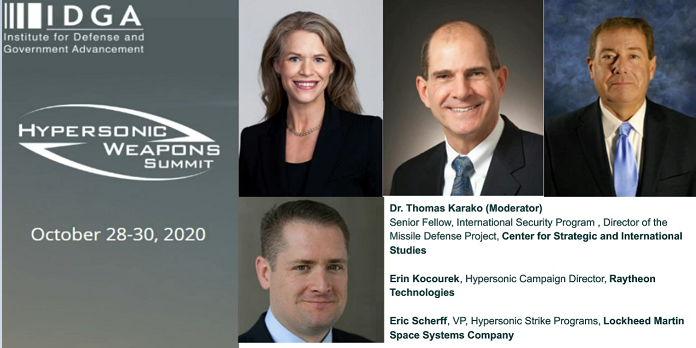
Industry Efforts to Enable DoD Hypersonic Goals: Lessons Learned and Opportunities Moving Forward
Join Dr. Thomas Karako, along with panelists as they discuss what lessons have been learned in DoD Hypersonic goals and what opportunities lie ahead
Driving USAF Science, Technology & Engineering Competencies to Meet the Future of Hypersonic
Download the video now to learn more about enabling future USAF hypersonic capability fielding as well as Hypersonic policy guidance for USAF’ $2 billion S&T program
Traditional Heat Transfer and Fluid Mechanics Investigations for Hypersonic Flight
View Dr. Ligrani session as he discusses - Next-generation efforts to advance heat transfer, - Modeling and data needs and more.
Accelerating Hypersonic Technology Development and Transition to Advanced Capability
Join Dr. Bussey, as she covers Guiding DoD strategy and roadmap for hypersonic S&T and much more.

Bolstering Strategic Deterrence and Global Strike Combat Support via Integration of Hypersonic Capabilities
Join General Ray as he discusses Operational concepts as well as Lessons learned thus far to inform future ops

Advancing Challenging Aerothermodynamic and Propulsion System Phenomena via Hypersonic Vehicle Simulation
- Data modeling efforts to support continued hypersonic development
- Modeling, data, and simulation needs
- Partnership efforts across the DoD
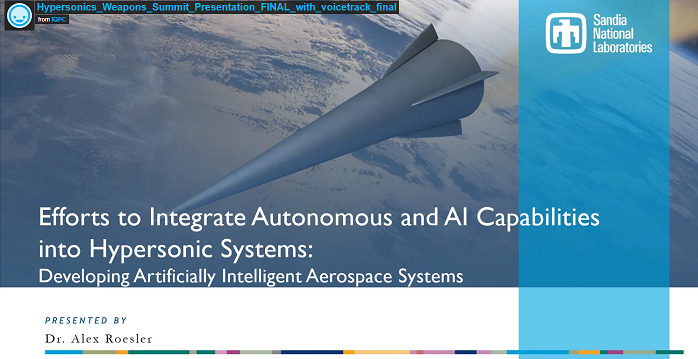
Efforts to Integrate Autonomous and AI Capabilities into Hypersonic Systems: Developing Artificially Intelligent Aerospace Systems
Join Dr. Alex Roesler as he discusses efforts to integrate autonomous system capabilities into hypersonic systems: near-term engineering challenges


SharpCloud - In the Business of Defense
The story of how Strategic Portfolio Management saved one public sector enterprise 10% in defence spending and transformed their weapon program.
This report covers:
- The importance of a holistic, configured network model in managing complex defense portfolios.
- The importance of subject matter expertise, organizational intellect and how AI will not ever replace this in the case of defence.
- The role of Portfolio Strategy and Roamapping software in transforming decision-making and reducing budget waste.
- Insights from the Head of Strategy and Planning from a large public defence organisation on the impact of visualization tools in a complex enterprise.
- How confident and mature leadership is critical to help handle transparency of data that digital technology provides.
- The future of enterprise network modeling in defense, driven by live, common datasets
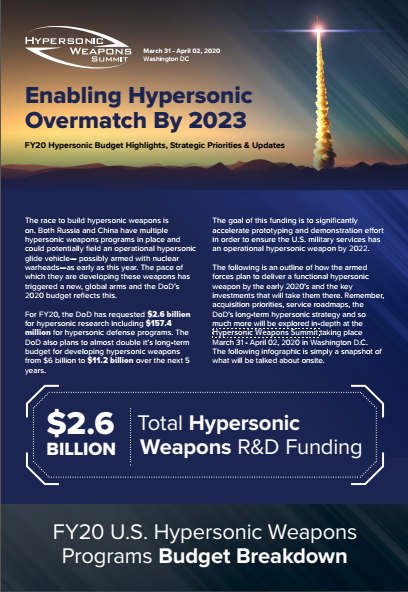
Enabling Hypersonic Overmatch By 2023
FY20 Hypersonic Budget Highlights, Strategic Priorities & Updates
The race to build hypersonic weapons is on. Both Russia and China have multiple hypersonic weapons programs in place and could potentially field an operational hypersonic glide vehicle— possibly armed with nuclear warheads—as early as this year. The pace of which they are developing these weapons has triggered a new, global arms and the DoD’s 2020 budget reflects this. For FY20, the DoD has requested $2.6 billion for hypersonic research including $157.4 million for hypersonic defense programs. The DoD also plans to almost double it’s long-term budget for developing hypersonic weapons from $6 billion to $11.2 billion over the next 5 years.
The goal of this funding is to significantly accelerate prototyping and demonstration effort in order to ensure the U.S. military services has an operational hypersonic weapon by 2022.
Our annual budget infographic is an outline of how the armed forces plan to deliver a functional hypersonic weapon by the early 2020’s and the key investments that will take them there. Remember, acquisition priorities, service roadmaps, the DoD’s long-term hypersonic strategy and so much more will be explored in-depth at the Hypersonic Weapons Summit taking place March 31 - April 02, 2020 in Washington D.C. DOWNLOAD our latest infographic to get a taste of what will be discussed onsite.
Hypersonic Weapons Summit 2022 Attendee List
Download the sample attendee list to see who you could meet at the 2022 Hypersonic Weapons Summit!
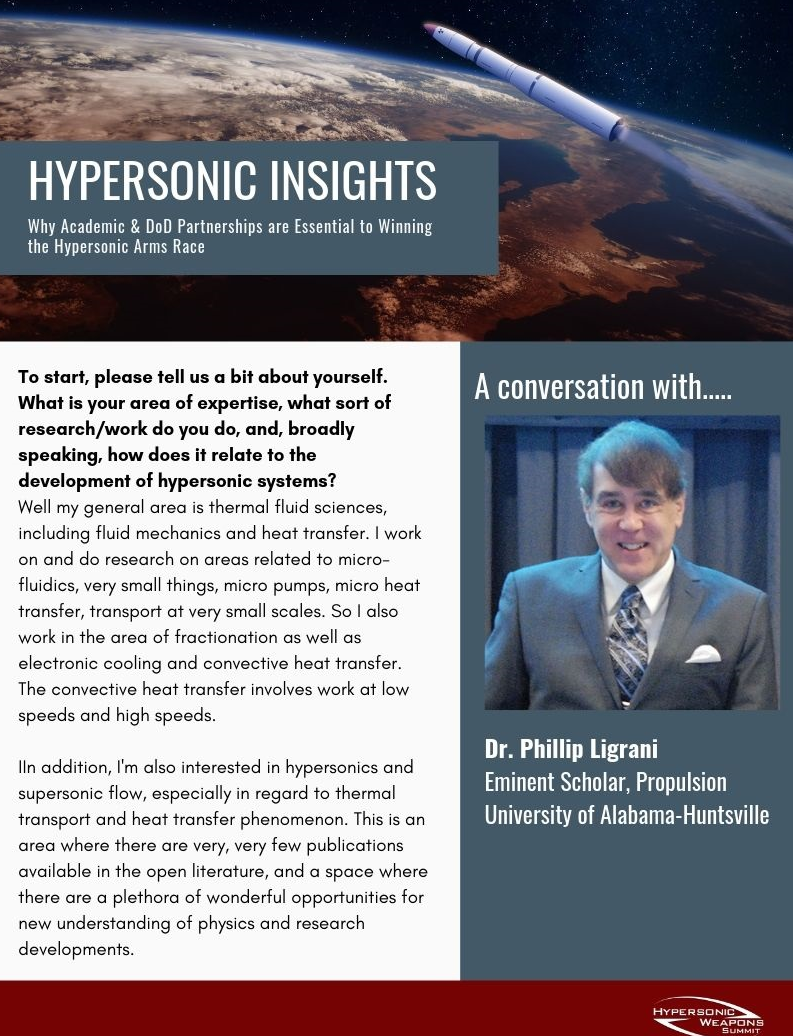
Why Academic & DoD Partnerships are Essential to Winning the Hypersonic Arms Race
Ahead of the 2019 Hypersonics event, we sat down with speaker Dr. Phillip Ligrani, Eminent Scholar, Propulsion University of Alabama-Huntsville to discuss the role of academic research in the development of hypersonic capabilities.
The Road to Hypersonic Weapons: Technical Challenges & Emerging Opportunities
In the eternal arms race to maintain or regain a strategic advantage over its adversaries, the United States is turning its attention to the development of hypersonic weapons. The concept of a hypersonic weapon is not new – indeed the U.S. has developed them in some form or another for over 30 years. Yet as its adversaries – Russia and China most notably – push the development of hypersonic weapons and near the ability to field them, the U.S. has begun to increase its focus and funding on catching up. This article will discuss the current status of the Department of Defense’s development efforts, it’s challenges, and opportunities for the defense industry to contribute!
Hypersonic Current Attendee Snapshot
Take a peek at who you can expect to network with on-site based on our 2020 Attendee Snapshot. Contact us today and find out more on how to join this list! Alternatively, feel free to send your request to Katrina.Savarino@idga.org to receive your copy via email.

The Next Frontier of Hypersonc Vehicles: NFL's Hypersonic Mission Vision
Dr. Prakash Vedula is the Founder, CEO and Chief Scientist of Next Frontier LLC. He is also a tenured Full Professor in the School of Aerospace and Mechanical Engineering at University of Oklahoma, Norman. He is a renowned expert in fast and reliable computational algorithms applicable to a broad variety of complex systems, including hypersonic systems, and he succeeded in making pioneering contributions to very challenging computational problems. He has a stellar CV and his innovations were published in many reputed peer-reviewed scientific journals. Prakash sat down with IDGA’s Deputy Director, Jon Sanders, about Next Frontier’s role in Hypersonic continuum!
Interview With Dr. Mark J. Lewis
As former Acting Deputy Under Secretary of Defense for Research & Engineering, amongst other positions, Dr. Mark J. Lewis oversaw the development of numerous critical defense technologies. In this interview, Dr. Lewis comments on the current state of hypersonic technology in the US and worldwide. He gives an in-depth answer to the question “Why hypersonics?” going into their importance while also addressing criticisms that have caught the attention of the US Congress. Finally, he expresses his views on how we should be moving forward. The interview offers:
- Critical insight into the arguments against hypersonic technology
- A snapshot of current Hypersonic efforts in the US
- An understanding of why hypersonic technologies are so crucial to the United States’ global security

2023 Snapshot of Attendees | IDGA's Hypersonic Weapons Summit
IDGA’s Hypersonic Weapons Summit 2024 will explore next generation hypersonic weapons efforts across the military & enable advancements through industry partnerships. Take a look at who attended the 2023 event to get an idea of who you will meet on-site this year!

Past Attendee Snapshot
Who can you expect to meet and learn from at the 2022 Hypersonic Weapons Summit? Download our Past Attendee List to find out!
Hypersonic Weapons 2019-2027 Market Report
In advance of our Hypersonic Weapons Summit, we have worked closely alongside our Partners Market Forecast in our mission to inform you of the latest innovations and key components of developing hypersonic missiles. Download this report today to find out more:
- Type Guidance System & Technology
- Global Supersonic & Hypersonic Weapons - Trends and Insights
- Hypersonic Weapons market by Regions
- Major conclusions and findings
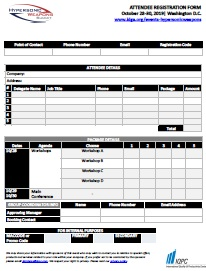
Registration Form
Registration for the Hypersonic Weapons Summit is easier than ever. Just download this registration form and send it to idga@idga.org with the subject line Hypersonic Registration.
Hypersonic Weapons Keynote Speaker Overview
They Hypersonic Weapons Team has but together this e-book that highlights the Government/Military Experts giving Keynotes at the upcoming Summit. Take a moment to read up on these Hypersonic Leaders.

U.S. Army Delivering Its Long-Range Hypersonic Weapon
The growth of the U.S. hypersonic industry has accelerated in the past decade as significant investments continue, notably in programs like Hypersonic Attack Cruise Missile, Army Long Range Hypersonic Weapon, and Navy Conventional Prompt Strike. While successful testing has brought hypersonic deployment closer for the United States, technological and operational challenges still exist in the space.
Dr. Mark Lewis, president and CEO of the Purdue Applied Research Institute (PARI), is well-versed in these challenges and the potential impact of hypersonics for the Defense Department. A renowned researcher, professor, and former deputy undersecretary of defense, Lewis brings a wealth of national security, scientific, and academic experience to the Institute for Defense and Government Advancement as chairman for the Summit in 2024.
Hypersonic Weapons Market Report
Keeping you informed on the latest Hypersonic innovations, technologies, budgets, policies, IDGA is excited to announce that we have recently partnered up with Next Frontier LLC for the production of our Hypersonic Weapons Report.
This overarching hypersonic market report includes updates as to Hypersonic Weapons development across the US, global and near-peer hypersonic efforts and so much more to include::
• Interview with Dr. Prakash Vedula – Founder, CEO and Chief Scientist of Next Frontier LLC
• Market Forcasting which covers the FY21 Budget, as well as the International development efforts
• IDGA Market Survey, which covers what the post-Hypersonic future looks like, the geostrategic political defense environment future,
and much more
Hypersonic Defense Report 2022
Few developments have caught the West as off guard as Hypersonic Weapons. As a result, several nations are scrambling to develop their own Hypersonic and countermeasure capabilities to stabilize geopolitical power dynamics. This report gives the most up to date review of the Hypersonic Defense landscape. Dr James Bosbotinis delivers an in-depth analysis of relevant programs and technologies, highlighting the complex nature of the problem facing western nations
Raytheon Technologies A Defense Power House
Raytheon Missiles & Defense forms a formidable industry force
Raytheon Missiles & Defense, a business of the newly formed Raytheon Technologies, is built on a foundation of advanced innovation and excellence in engineering. Offering speed, synergy and the complete threat solution, the business will help redefine its industry through transformative technologies and initiatives that bring a lasting benefit for global customers.
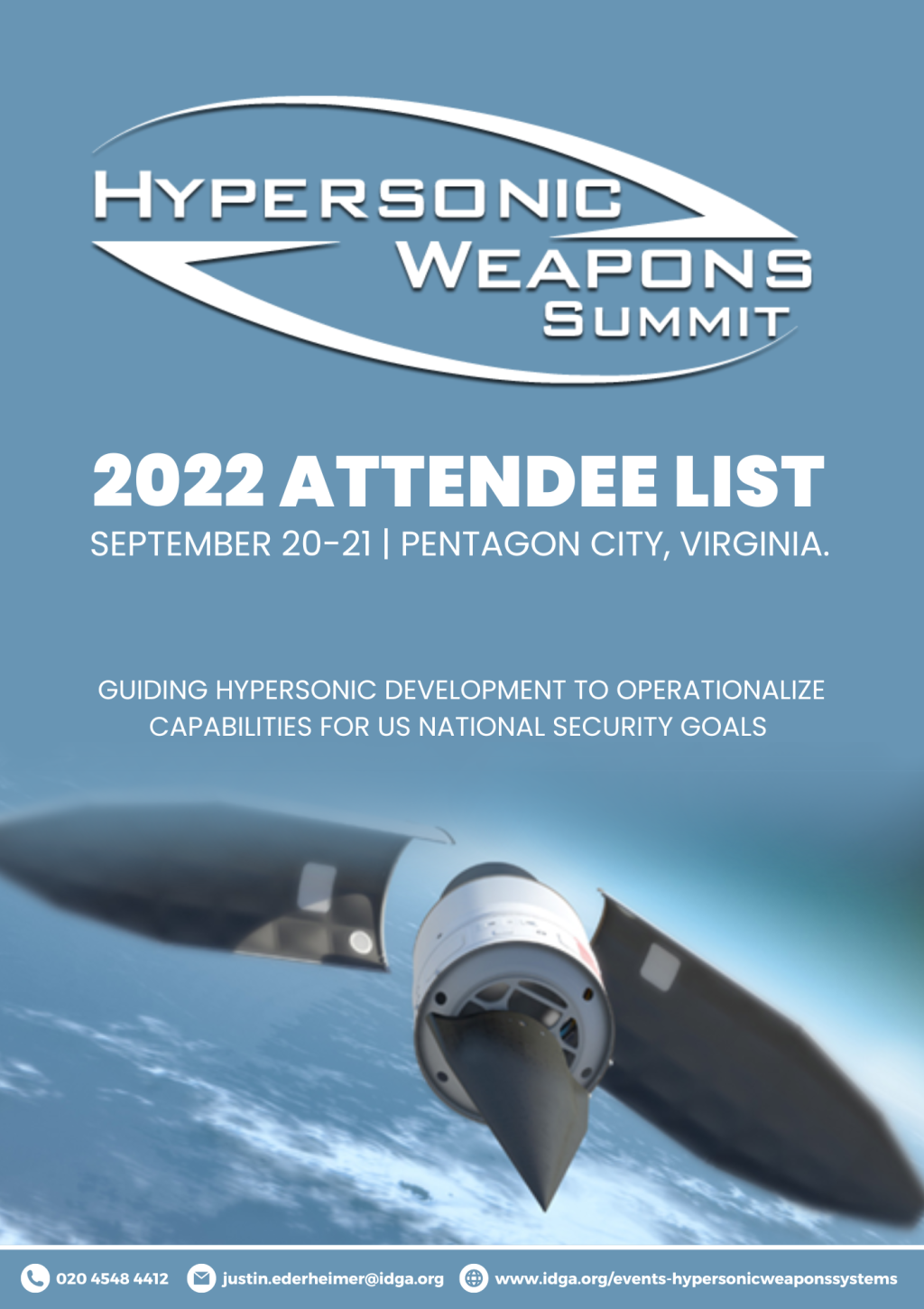
Hypersonic Weapon Systems - 2022 Attendee List
Ahead of the Hypersonic Weapons Summit 2023, the 2022 Attendee Report highlights the leading organizations within the industry and an extensive list of high-level attendees that have previously attended. This conference provides an opportunity for stakeholders from across the DoD, academia, and industry to get together for two days of networking, information sharing, thought leadership, and problem-solving to better achieve the goals of the US in Hypersonics.
In Partnership With:

QUESTIONS?
Contact us: +1 646 200 7515
Email: idga@idga.org

©2026 IQPC. All rights reserved.