Industry Insights
Answering FAQs About JIATF 401
The U.S. government is restructuring how it develops, acquires, and deploys counter‑UAS capabilities in response to the rapid proliferation of drones. This infographic breaks down the role of Joint Interagency Task Force 401 (JIATF 401)—the Pentagon's new central hub for coordinating counter‑drone efforts across military, federal, and homeland security stakeholders.
Read to learn:
- How JIATF 401 is streamlining counter‑UAS efforts through centralized testing, acquisition, and interagency coordination to respond faster to emerging drone threats.
- What the new Counter‑UAS Marketplace means for government and industry, including faster procurement, standardized performance data, and expanded opportunities for advanced counter‑drone technologies.

A Beginner's Guide to the DoW's New C-UAS Marketplace
As the threat posed by low‑cost, proliferated drones continues to grow, the Department of War is changing how it acquires and fields counter‑UAS capabilities. This report serves as a practical introduction to the DoW's newly launched C‑UAS Marketplace, overseen by JIATF401, and explains how the platform is designed to accelerate access to vetted counter‑drone solutions.
Read this report to gain:
- A clear overview of the DoW's new C‑UAS Marketplace, including how it works and why it represents a shift in counter‑drone acquisition.
- Insight into the types of C‑UAS capabilities the DoW is prioritizing and how industry can align with emerging requirements through the Common Hardware Systems electronic catalog.
JIATF 401 and the Future of U.S. Counter-Drone Operations
The rise of low-cost drones in battlefields and across U.S. airspace has driven a major shift in how the Department of War approaches counter‑UAS. This report examines the creation of Joint Interagency Task Force (JIATF) 401, why it was established, and how it is reshaping U.S. counter‑drone strategy, acquisition, and interagency coordination.
In this report, readers will gain:
- A clear explanation of why JIATF 401 was created and how its expanded authorities differ from prior C‑UAS efforts, including its role in accelerating acquisition and fielding.
- Insight into what JIATF 401 means for industry and government stakeholders, from the new C‑UAS marketplace to growing demand for interoperable, layered counter‑drone solutions.
The Impact of President Trump's Counter-UAS Executive Order One Year Later
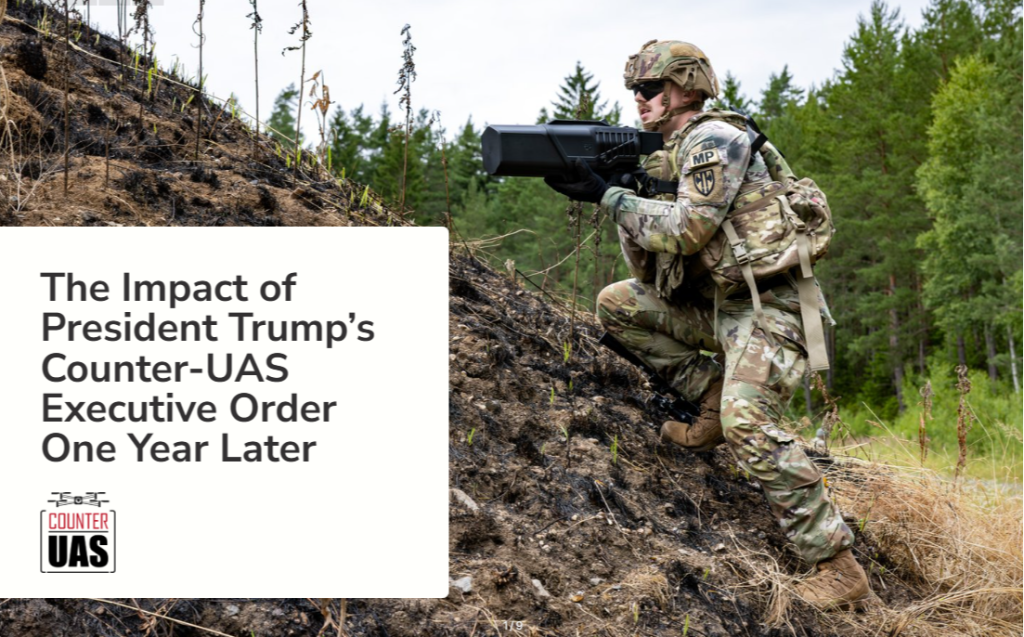
One year after the signing of the "Restoring American Airspace Sovereignty" executive order, the U.S. government is accelerating efforts to counter the growing threat of malicious drone activity. This report examines how federal agencies are implementing new authorities, expanding coordination, and strengthening counter‑UAS capabilities to protect critical infrastructure, public events, and national security assets.
Key highlights include:
- How the executive order is reshaping federal roles—expanding the FAA's regulatory authority, strengthening DOJ enforcement, and increasing DHS and DoD coordination to build a unified counter‑drone framework.
- Real progress one year later, including new airspace restriction rules, funding for state and local counter‑UAS capabilities, and enhanced intelligence sharing to detect and respond to evolving drone threats.
Aligning Industry and Law Enforcement in the Fight Against Drone Threats
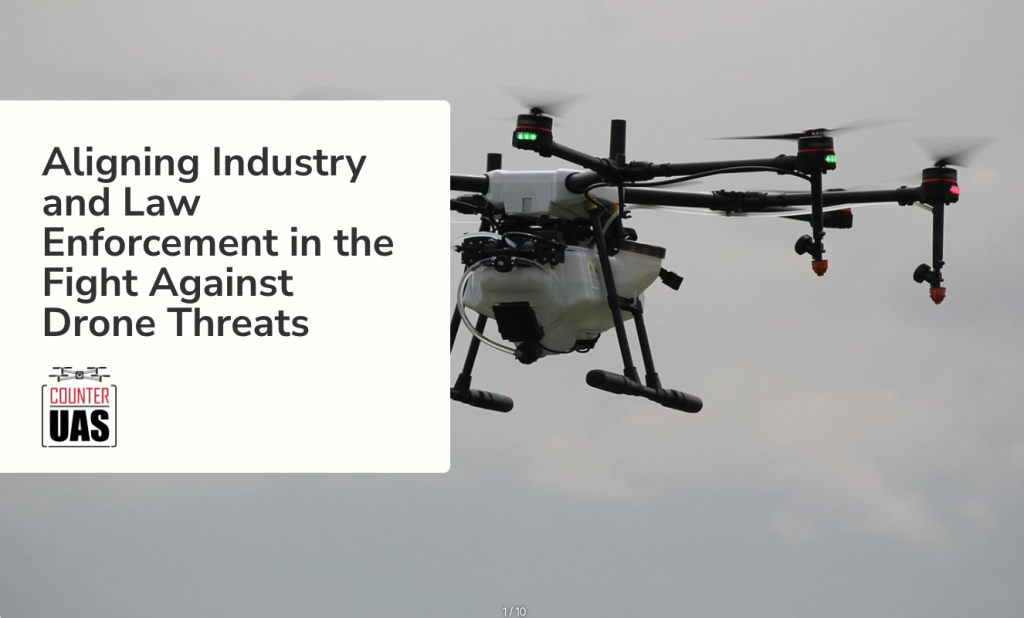
As drone threats to critical infrastructure grow, effective counter‑UAS efforts increasingly depend on coordination between government, law enforcement, and the private sector. In this exclusive interview, Scott Parker, Founder of Aerisq Solutions and former Chief of UAS Security at CISA, shares practical insights on how legislation, information sharing, and operational collaboration are reshaping the national response to unmanned threats.
Download to learn:
- Clarity on how new authorities, including the Safer Skies Act, are changing the speed, scope, and structure of counter‑UAS response for state and local law enforcement.
- Real‑world perspectives on collaboration challenges and solutions, including information‑sharing gaps, private‑sector detection roles, and what an effective nationwide counter‑drone framework could look like.

The DoD's Latest C-UAS Strategies
The emergence of highly capable unmanned aerial systems (UAS), such as drones, has left law enforcement organizations across the U.S. scrambling to establish new procedures and solutions to mitigate risks posed by drone incursions in US airspace.
The Department of Defense (DoD) is one of several federal government agencies that are continually updating their Counter-UAS (C-UAS) procedures. In the case of the DoD, to secure its 450+ bases across the states. The North American Aerospace Defense Command (NORAD), which provides aerospace warning and aerospace command in North America, and the U.S. Northern Command (NORTHCOM) are responsible for securing the airspace around military bases.
This report will break down the latest efforts from the DoD to counter drone incursions. Those efforts include:
- NDAA funding
- New C-UAS procedures from NORTHCOM
- DoD department-wide strategy

How FIFA is Planning to Mitigate Drone Risks at the 2026 World Cup
In the winter of 2022, a record 1.5 billion people tuned into the FIFA World Cup Final. Additionally, nearly 3.5 million people made the journey to Qatar to watch the games in person, making the tournament one of the most popular sporting experiences in the world.
In 2026, the World Cup will welcome millions more fans to games in 12 cities across North America. One of the individuals responsible for ensuring the safety of both players and fans is G.B. Jones, Chief Safety & Security Officer of the 2026 FIFA World Cup.
One of the major threats to security at the World Cup, as well as many major sporting events around the world, is drones. Unmanned aerial systems (UAS) such as drones can carry harmful objects, disrupt games, and be hard to detect, all of which GB and his team are aware of before the World Cup begins in June 2026.
Before IDGA’s 2025 Counter UAS Summit and the World Cup, G.B. sat down with IDGA to discuss how his team is preparing for UAS threats and how they plan to mitigate them.
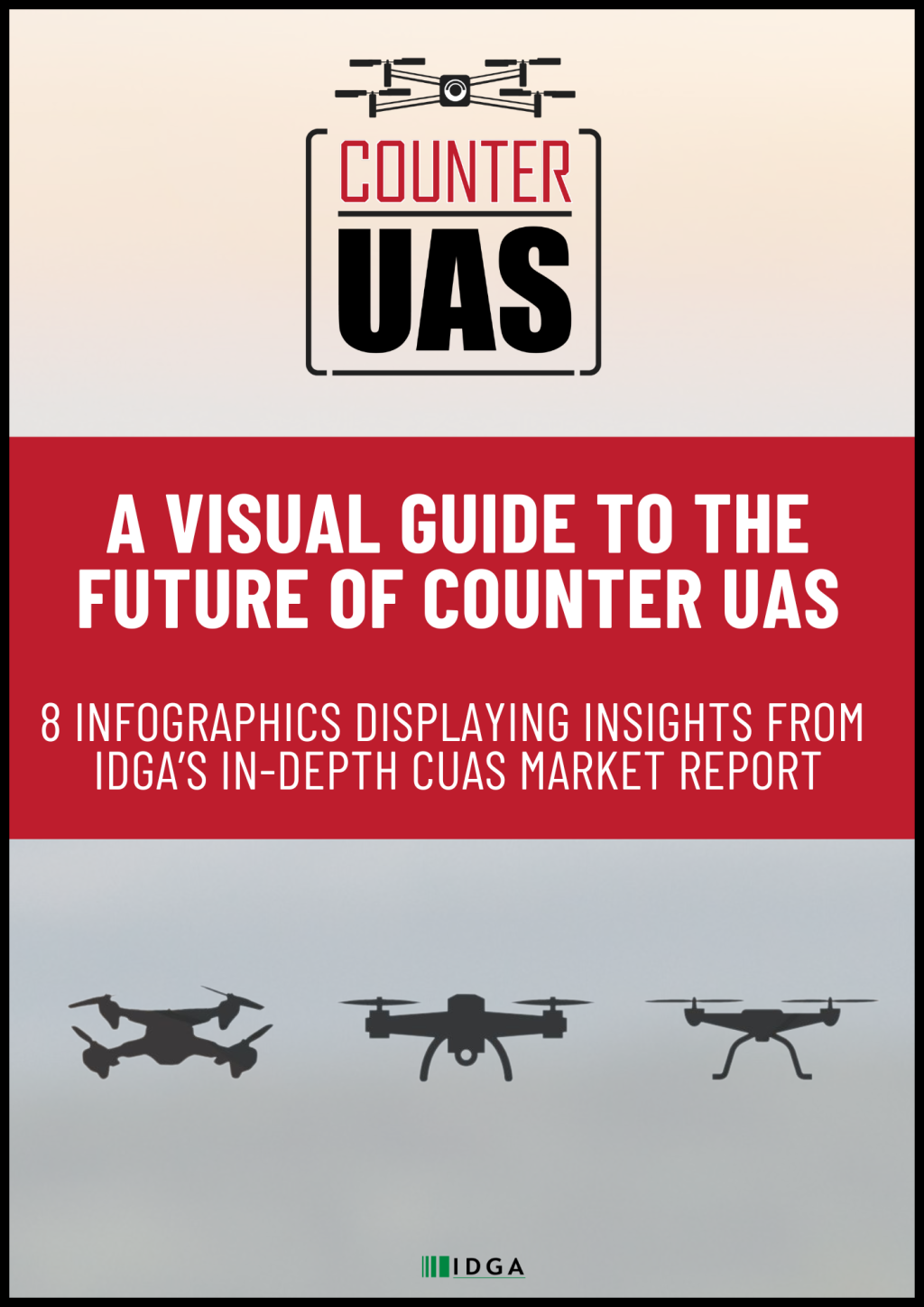
A Visual Guide to the Future of Counter UAS
Recent global conflicts have underscored the widespread use of Unmanned Aerial Systems (UAS) in military scenarios. This rapid proliferation of UAS has introduced new threats, such as unauthorized surveillance, privacy breaches, airspace obstruction, and the potential use of drones for carrying destructive payloads.
In response to these challenges, there is an urgent need for effective counter-UAS (C-UAS) technology. Countries are increasingly procuring systems for detection, identification, tracking, alerting, jamming, spoofing, and neutralization of rogue drones. The global market for C-UAS technology is expected to quadruple between 2021 and 2031.
The latest visual guide from IDGA outlines how the American Counter-UAS (C-UAS) market is responding to the rise of drones flying in U.S. airspace. The guide provides insights into the following:
- Kinetic vs non-kinetic C-UAS solutions
- C-UAS market size in the U.S.
- FAA No Fly Zones

Counter UAS Market Report 2024-2029
This rapid proliferation of UAS has introduced new threats, which are particularly pronounced in civilian airspace, where incidents involving drones have surged. From 2021 to 2023, the Transportation Security Administration (TSA) reported over 2,000 drone sightings near U.S. airports, including incidents that required pilots to take evasive actions. In the first four months of 2024 alone, the FAA recorded 326 drone-related incidents near airplanes, helicopters, and airports, highlighting the growing security risks.
In response to these challenges, there is an urgent need for effective counter-UAS (C-UAS) technology. The global market for C-UAS technology is expected to quadruple between 2021 and 2031. Notably, integrated defense networks that combine various detection and mitigation technologies are proving more effective than isolated systems, as evidenced by a U.S. Army assessment.
The following report will analyze the currently evolving C-UAS market, examine current trends, technological advancements, and future efforts to address the growing challenges posed by UAS proliferation.

Counter-Drone Strategies and Innovations for Urban Areas
Drones are increasingly prevalent in public settings across the U.S. In fact, the drone industry in the states has grown to $6.39 billion in 2024. One place where drones pose a significant threat to American citizens is densely populated urban areas. Responding to these drone threats requires the foresight to educate the population on flying drones, proper counter UAS (CUAS) measures, and cohesion amongst several long enforcement.
DJ Smith is the CUAS Systems Program Coordinator for the Virginia State Police, and in his role he has a wealth of experience in responding to drone incursions. During the CUAS Summit, Smith will participate in a panel discussion on challenges and solutions for counter-drone operations in urban areas. Before the conference, Smith sat down with IDGA to preview his session at the Counter UAS Summit and discuss the work the Virginia State Police is doing to mitigate drone risks in urban areas.
IDGA’s Counter UAS Summit takes place August 27-28 at the Crystal Gateway Marriot in Arlington, Virginia. During the two-day event, high level discussions will be held surrounding kinetic and non-kinetic approaches for countering drones, including exploring case studies on specific incidents, insights into the latest innovative CUAS technologies, the impact of shifting legal authorities, and much more.
In Partnership With:
QUESTIONS?
Contact us: +1 646 200 7515
Email: idga@idga.org

©2026 IQPC. All rights reserved.