Rise of the 'Real' Skynet?
Posted: 07/27/2010 12:00:00 AM EDT | 5
|
In James Cameron’s famous “Terminator” film series the primary antagonists are killer cyborgs (Arnold Schwarzenegger plays the role in the first film), that are hunting John Connor, the only hope for the survival of humanity after nuclear fallout.
However, the real villain in these wildly popular movies is a computer network named Skynet that has become self-aware and thus has become a true form of artificial intelligence. It is Skynet that initiates the atomic attack against humanity and is masterminding the extinction of humans via control of its brutal Terminator cyborgs. In the movie this advanced computer system is created by a collaborative effort between a fictional major defense contractor called Cyberdyne Systems and the United States Air Force Strategic Air Command.
This film franchise isn’t the first time that it has been proposed that some sort of advanced computer intelligence designed by humanity could eventually turn on its creators. This storyline has been passed around as early as 1964 in Arthur C. Clark’s short story “Dial F for Frankenstein.” Or the 1966 “Doctor Who” serial “The War Machines” that featured an antagonistic supercomputer named WOTAN.
The older versions of this archetype portray a brand of science fiction that feels more like fantasy than reality. Scenarios that seem well suited and written for purely entertainment purposes and could never come to pass, much like a Harry Potter film. However, in Cameron’s Terminator movies (especially the latter ones) this archetype of cybernetic revolt has a more real-to-life and threatening feel.
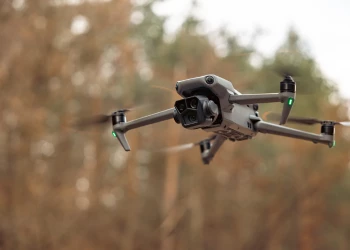
This is clearly due to the rapid advances in military technology that have entered the battlefield in the 21st Century. OIF and OEF are the first wars where it is a common site to see a UAV patrolling the skies for ground based threats. There are even unmanned drones that can launch offensive attacks that are controlled from hundreds of miles away.
A recent article featured on Yahoo! News displays a new aircraft unveiled by the UK’s MoD named Taranis. It is unmanned and is capable of “long range strike missions”. Further, it is heralded as the “combat aircraft of the future”. As if to really say, “goodbye manned strike-fighters we won’t need you anymore”. This article makes a quote in Cameron’s T2: Judgment Day (uttered by Arnold’s T-101 Terminator) sound eerily like a forewarning and prediction of things to come. The Terminator says something to this effect, “All stealth bombers become unmanned and are updated with Cyberdyne software. They fly with a perfect operational record.”
Taranis’ sleek shiny exterior, clean lines and strange red triangular “eye” in its center look as if it could have been dreamed up by Cameron himself. It wouldn’t have appeared out of place in the sky in one of the many future battle sequences in the film series that depict unmanned aircraft controlled by Skynet patrolling the sky in the post apocalyptic world.
Another alarming article published by Defense News and out only weeks apart from the MoD Taranis piece is about lethal robot sentries being deployed along the Korean DMZ. According to the article this robot will act as a sentry and is capable of detecting and killing intruders along the border. It also is said to have capabilities of surveillance, tracking, firing, and voice recognition. Again, this could be a description taken straight from a 1984 Terminator film script.
Of course all of the evolving technology in the form of robots and unmanned aircraft are meaningless in a “Terminator” comparison without the aforementioned Skynet. So where does a something like Skynet fit into modern day warfare? Is it something that still only exists in the imaginations of men like James Cameron and the minds of all sci-fi movie fanatics?
DARPA which stands for The Defense Advanced Research Projects Agency is a Pentagon controlled organization that is responsible for developing new technology to be used by the military. One of the DARPA projects called Deep Green is a computer system that is supposed to serve as a decision making support system for military commanders. It is reported to have advanced predictive capabilities which can enable computers to efficiently and accurately predict possible future scenarios. It has been dubbed “General in a box”.
It is important to note that all of the above mentioned programs are completely within the control of human decision making at this point and are all tools to achieve maximum mission accomplishment with the use and loss of minimal resources. In no way are these anywhere close to the film versions of Skynet and Terminators. However, it seems clear that James Cameron’s vision of 2029 is not completely a far fetched dream in 2010. Many of the developing military programs have striking similarities to his ideas.
So it’s worth asking: if we’ve reached a point in human history where we trust our investment decisions to primitive versions of artificial intelligence and let early stage robots operate on our bodies and teach our children, then just how far away can we be, really, from giving a machine tactical independence on the battlefield.
Maybe not so far.
Not so far at all.
So … are you nervous yet?
No?
Then consider this: there are folks at the U.S. Navy’s Office of Naval Research who are much, much smarter than you or I – and they are nervous.
-
Gaming Gadgets and Developing Simulation Technologies -
Program Office Pitfalls When Crafting A PBL BCA Type II Study -
Wikileaks - More Smoke than Fire? -
Smartphones, Jailbreaking and the New Battle Front for Enterprise Security -
Future Ground Forces Interview with Dr. Carole Teolis -
Piracy Fight Changing Shape as Somali Pirates extend Reach xxx -
Wanted - A Coalition Leader xxx -
Network Solution for the Last Tactical Mile xxx -
Have We Built a Strong Enough Sustainment Bridge to Support the US Army Unmanned Aircraft System Road Map? xxx -
DOD and UK MoD Up Investment in Submarine Programs xxx
|
|
I may be influenced by having a background in organic chemistry and the neuromorphology of behavior. Many of the people I know are engineer's. They fear machines w/what is adaptive behavior in certain environment's. So do I. Where we differ is I'm in favor of creating organisim's w/ a true sense of identity. Ego or "personhood". It's from there we get all the subjective, "illogical" behavior, that includes remorse, and hope. We juggle what is often terrible behavior, with the ability to change what does not even exist, but we just know we must. The problem is if one of these entitie's got depressed, I'll be damned if I would know who to send him to.
|
|
|
We already deploy robotic weapons that autonomously identify and kill targets without intervention from a man-in-the-loop and have deployed them for many, many years. Air-to-air and surface to air and air to surface missiles are largely in this category. Once the weapon is launched, it's often times on it's own to ensure the right target is destroyed. 99.99% of electronic systems are single-point failure, so if anything goes haywire the thing totally stops functioning or functions in a totally uncontrolled way.
We're on the verge of simulating a cat brain. Simulations approaching a human brain are at least a decade away. The hardware for these simulations are loaded with single-point failures, but the thought that a robot would fail in a way that makes it continue to function in a way that is useful to the robot is still a long way off.
|
|
|
Nick, great topic. I would highly recommend you read Ray Kurzweil an American inventor and perhaps one of the best known technology futurists. He has made some startling predictions regarding what he calls, "The Singularity Event", where he discusses how we will be able to enhance our bodies and minds with technology. He describes the singularity as resulting from a combination of three important technologies, genetics, nanotechnology, and robotics (including artificial intelligence).
Thanks again for the post.....As Arnold would say.."I'll be back"...
Jim D
|
|
|
Interesting essay Nick. If I'm not mistaken, South Africa had a robotic anti-aircraft gun go haywire in 2007. I recall that a number of soldiers were killed and injured by the robotic unit's "friendly fire" before they could pull the plug. We may be even closer than you infer!
|
|
|
As you mentioned the TV series as they twiddled with AI's.
Here's an appropriate response from the series Andromeda:
"Worlds governed by Artificial Intelligence often learned a hard lesson: Logic Doesn't Care."
|
-
RFID Asset Management Solutions: Improving Asset Accountability and Audit Efficiency
August 4, 2010
Register Now -
‘Unmanned Mission Impossible’ - 4 Steps to Conquering the UAV Human Machine Interface
November 10, 2010
Register Now -
Successful Antenna Integration on Military Platforms
October 3, 2012
Register Now -
Successfully Estimating COTS Costs in Weapon System Lifecycles
August 17, 2010
Register Now


Replies (0)
Not a member? Sign Up
Reasons for Joining
Address your challenges through knowledge sharing with peers from our global network of specialists.
Benchmark your business initiatives with the who's who in the field.
Hear from industry pioneers how to maximize ROI in today's challenging economy.
And best of all It's FREE!